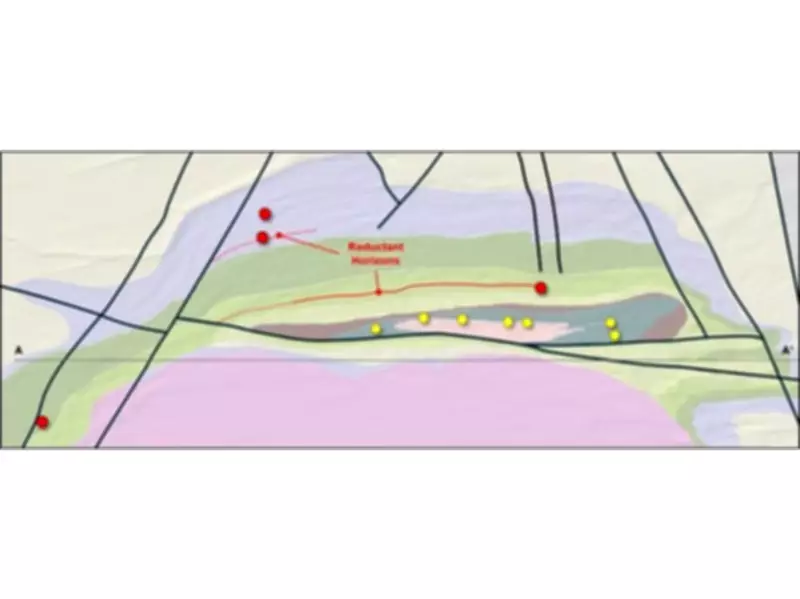
VANCOUVER, British Columbia – Viridian Metals Inc. has made a significant breakthrough in understanding the geological architecture of its Sedna Project in Labrador, Canada. The company has confirmed the presence of deeply rooted, crustal-scale plumbing systems that drive extensive sediment-hosted copper mineralization throughout the Seal Basin.
Uncovering a District-Scale Copper System
Through the integration of newly acquired magnetotelluric (MT) data with detailed surface mapping, Viridian has defined a comprehensive geological framework that underpins what appears to be a district-scale mineralizing system. This framework connects deep-seated fluid sources to favorable surface horizons, establishing the structural foundation of an emerging copper district that shows remarkable similarities to major sediment-hosted copper districts worldwide.
Key Geological Discoveries
The research has yielded several critical findings that substantially advance understanding of the Sedna Project's potential:

Confirmed Multi-level Plumbing System: MT data has successfully imaged deeply rooted, north-south oriented structural breaks that penetrate the lithosphere. These features, extending vertically for tens of kilometers beneath the basin, likely served as primary conduits for transporting copper-rich fluids from depth to surface environments.
Identification of Basin-Scale Copper Traps: Viridian has delineated copper-bearing reduced horizons that extend laterally over tens of kilometers at favorable stratigraphic levels. These extensive reductant traps represent the chemical environments capable of capturing and concentrating copper from circulating mineralizing fluids.
Discovery of Widespread Disseminated Mineralization: The research has revealed fine-grained, disseminated chalcopyrite mineralization that is not visible in hand specimens. This subtle mineralization style explains why historical exploration efforts overlooked the system's true potential and is characteristic of large sediment-hosted copper deposits globally.
Structural Complexity and Scale
The Sedna Project covers more than 2,600 square kilometers, securing the majority of the Seal Basin and positioning it among the largest contiguous exploration projects in Canada. This extensive land position enables systematic basin-wide targeting and comprehensive evaluation of the mineralizing system.
Regional structural mapping and satellite imagery analysis have independently identified laterally extensive east-west oriented structural corridors traceable for over 100 kilometers across the project area. These shallow structures intersect at high angles with the deeply rooted north-south features imaged by MT, creating a vertically layered and geometrically complex plumbing system that provides multiple opportunities for fluid focusing and fluid-rock interaction.
Executive Perspective
"We have moved from a theoretical model to a proven framework," stated Tyrell Sutherland, President and CEO of Viridian Metals. "By confirming both the deep-rooted plumbing systems and the extensive copper-bearing horizons, we have significantly de-risked the project. We aren't just looking for a single deposit; we are uncovering an entire copper district."
The MT survey results culminate a year-long, basin-scale exploration program focused on evaluating the fundamental controls on fluid flow, metal transport, and deposition across the project area. These findings validate a key component of Viridian's copper exploration thesis and provide a robust geological foundation for future exploration targeting.
The integration of multiple datasets has created a comprehensive geological model that illustrates the structural architecture linking deep-seated fluid pathways to favorable trap positions within the basin. This model demonstrates how crustal-scale features connect to surface mineralization, providing a roadmap for systematic exploration of what appears to be a significant copper-bearing system in eastern Canada.