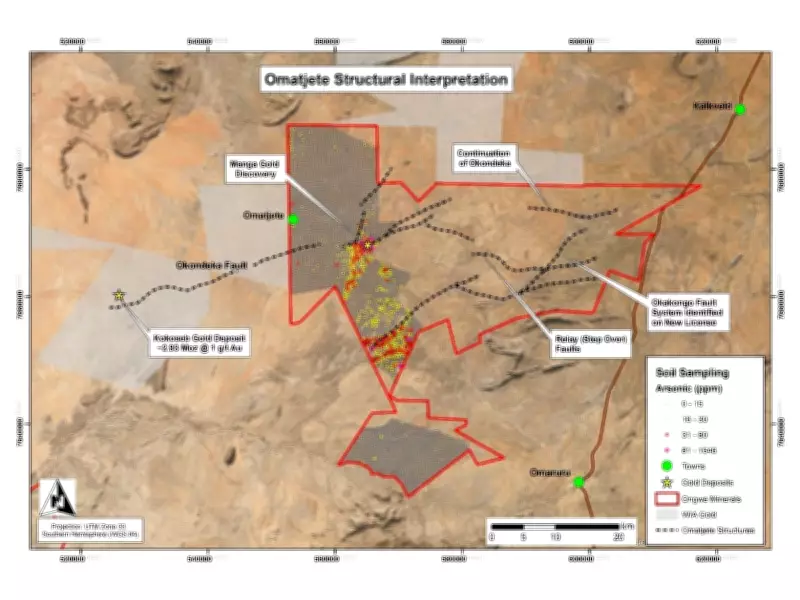
Ongwe Minerals Inc. has reported significant expansion of the Manga bedrock gold anomaly at its Omatjete Gold Project in Namibia. The company announced that bedrock sampling indicates the mineralization continues eastward under thick calcrete cover, with the current defined mineralization stretching over 2 kilometers.
Key Highlights from the Manga Prospect
Bedrock sampling at Manga has revealed an eastward continuation of mineralization beneath thick calcrete cover. The mineralization widens and remains open towards the east, with increasing bedrock assay results indicating potential to improve the overall size, quality, and economic discovery potential of the prospect. The bedrock sampling program has been extended to continue tracing the mineralization eastwards under calcrete cover.
Assay Results
Fire assay results for bedrock samples from Manga have been received, ranging from background to a highest value of 470 parts per billion (ppb). Twenty samples returned values over 100 ppb. The mineralization increases in grade and width towards the east, with line 13 (the most eastern completed line) showing mineralization over 80 meters in width greater than 200 ppb.

Confirmation of Gold Anomaly
Bedrock drilling at the Manga gold prospect has confirmed a well-defined, 2-kilometer-long, in-situ gold anomaly, with the rig still active at the eastern extension. The program revealed that the highest grade soil anomaly does not directly correlate with the highest grade bedrock anomaly, and the in-situ mineralization increases eastward of the main soil anomaly.
CEO Commentary
Dave Underwood, Ongwe’s CEO, commented: “The latest results from the Manga target confirm our expectation that the mineralization continues to the east under thick calcrete cover. The surface soil anomaly dissipates towards the east, however by using the well proven bedrock sampling technique we have been able to define a significant expansion of mineralization at the Manga prospect under cover.”
Underwood added: “When the Manga surface discovery was first made in late 2024, a series of scout RC holes were drilled across the centre of the anomaly, which intercepted wide, low-grade mineralization. It is now clear that these holes were drilled more than 1 kilometer west of the start of higher-grade mineralization. This is an exciting development, and we’ve decided to extend the bedrock sampling program to keep chasing the mineralization which is hidden under soil and calcrete cover. We will also test blind magnetic targets now that we know there is thick calcrete cover exceeding 10 meters in some areas.”
Underwood noted that as VP Exploration at Osino Resources between 2016 and 2024, he pioneered and successfully used this exploration technique which ultimately resulted in the large-scale Twin Hills gold discovery.