Highlander Silver Corp. has unveiled what it calls exceptional assay results from shallow drilling at its Bonita vein system in central Peru, marking both record-high grades and the discovery of a new mineralized zone. The company, trading on the TSX under the symbol HSLV, released the findings on December 1, 2025.
Record-Breaking Intervals and a New Discovery
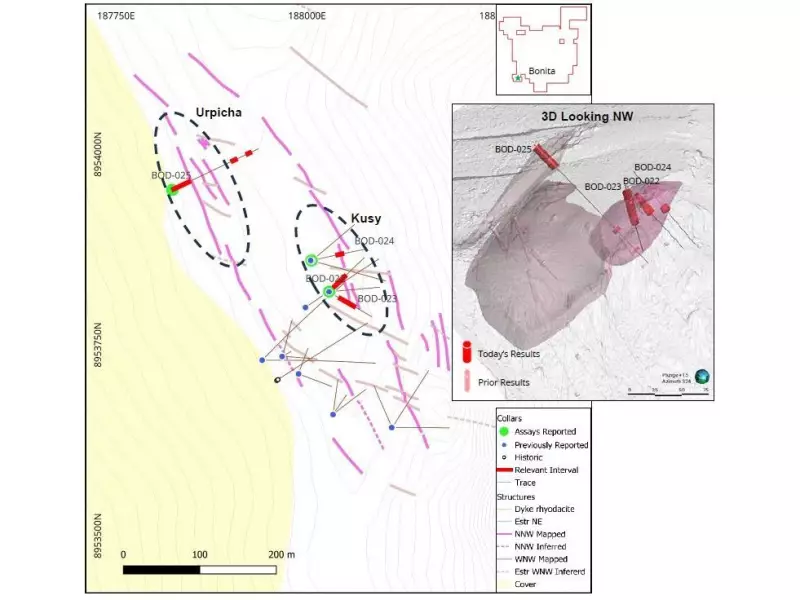
The latest drilling campaign has yielded some of the strongest results to date for the explorer. Hole BOD-023 intersected 23.9 metres grading 20.82 grams per tonne (g/t) gold and 31.53 g/t silver starting at a depth of just 21.0 metres. Another nearby hole, BOD-022, returned 23.4 metres of 11.70 g/t gold and 26.10 g/t silver from 13.5 metres depth.
Perhaps more significant for the project's expansion is the discovery of a new zone, named Urpicha, located over 200 metres northwest of previous drilling along the trend. Hole BOD-025 hit 27.0 metres of 5.28 g/t gold and 52.97 g/t silver from near surface at 2.3 metres downhole, confirming the system's potential to host strong, shallow mineralization in this new direction. The zone remains open along strike, with multiple parallel structures yet to be tested.

Location and Project Context
The Bonita vein system is situated approximately 10 kilometres south of the company's high-grade Ayelen deposit, within the broader San Luis gold-silver project in Peru. The recent shallow drilling highlights the system's growing scale and continuity.
The results from holes BOD-022 and BOD-023 further define the high-grade Kusy zone, building on previously reported strong intercepts. The new Urpicha discovery from BOD-025 extends the known mineralized footprint significantly to the northwest.
Next Steps and Future Exploration
Highlander Silver is currently integrating all data from its Phase I program. This includes the latest drill assays, mapping, soil sampling, and the results from a drone-based geophysical survey covering over 5,000 hectares. The goal is to identify new targets that share similar structural and geophysical signatures with the recently drilled mineralization.
Preliminary analysis has already highlighted several promising new target areas to the west under cover, to the east, and along strike. The company expects a complete analysis to be ready in the New Year, which will inform the design of an optimal drilling campaign for Phase II.
The reported drill intervals are considered apparent widths, as the full geometry of the mineralized structures is still being modelled. Composite intervals were calculated using a minimum weighted average of 0.5 g/t gold over a minimum core length of 2 metres, with no high-grade assays capped.