Early Exploration Success Extends Gold Mineralization at Juby Project
McFarlane Lake Mining Limited has announced promising early results from its ongoing exploration campaign at the 100%-owned Juby Gold Project, located west of Gowganda, Ontario, within the southern Abitibi Greenstone Belt. The company's recent drilling activities have successfully extended known gold mineralization and revealed significant new discoveries that could enhance the project's overall mineral potential.
Visible Gold Confirmed in New Drill Core
One of the most exciting developments comes from drill hole JU826-142, which has logged 20 separate occurrences of visible gold over an 11-metre interval beginning just 33 metres below the surface. While assays for this specific interval remain pending, the visual confirmation of gold presence represents a highly encouraging indicator for the project's mineral richness. This discovery suggests the potential for substantial gold concentrations within accessible depths of the deposit.
826 Zone Expansion and Near-Surface Mineralization
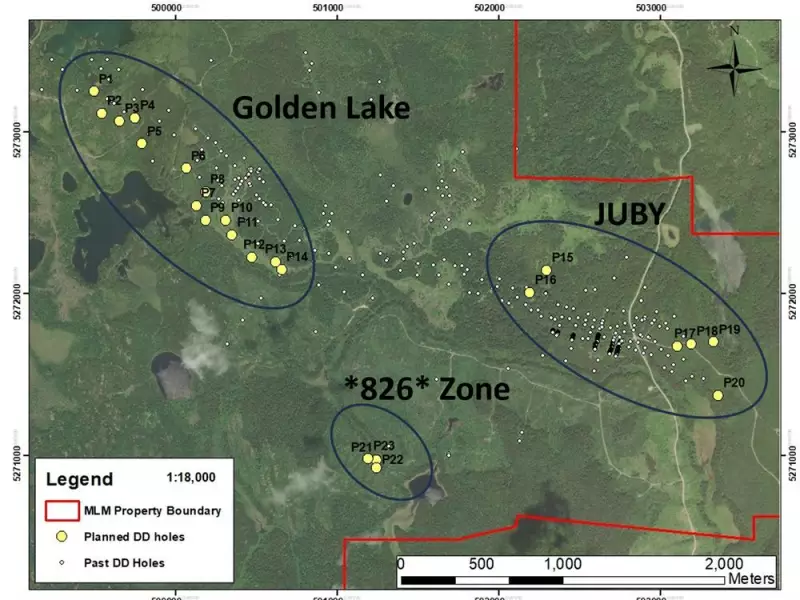
The company's early drilling efforts at the "826 Zone" have successfully expanded the gold system, extending known mineralization by up to 80 metres beyond previous boundaries. Drill hole JU826-141 intersected near-surface gold mineralization within just 20 metres of the surface, returning assay results of 2.09 grams per tonne (g/t) gold over 4.17 metres. This interval falls within a broader mineralized zone measuring 0.70 g/t gold over 28.17 metres, indicating consistent gold presence across a substantial vertical section.

In response to these promising early intersections, McFarlane Lake Mining has approved an additional 500 to 600 metres of drilling to further define and delineate the 826 Zone. This expanded drilling program aims to better understand the zone's geometry, continuity, and overall economic potential.
Historical Core Reanalysis Yields Significant Results
Beyond new drilling, the company has been systematically reanalyzing previously unsampled drill core from historical drilling campaigns conducted between 2003 and 2011. This retrospective examination has revealed several significant gold intersections that were previously undocumented, including:
- JU-03-36: 7.2 g/t gold over 1.2 metres
- JU-03-31: 0.65 g/t gold over 4.75 metres
- JU-11-112: 0.77 g/t gold over 3.69 metres and 0.48 g/t gold over 4.60 metres
These results from historical cores have effectively expanded the mineralized footprint of the Juby gold system, demonstrating that earlier drilling campaigns intersected gold mineralization that remained unquantified until now. The 7.2 g/t gold intersection from JU-03-36 represents particularly high-grade mineralization that could significantly impact the project's overall resource estimation.
Strategic Implications and Future Exploration
The combination of new drilling success and historical core reanalysis provides McFarlane Lake Mining with multiple vectors for expanding the Juby Gold Project's mineral resource. The visible gold discoveries, near-surface mineralization, and high-grade historical intersections collectively suggest a robust gold system with both lateral and depth potential.
Located within the prolific Abitibi Greenstone Belt—one of Canada's most productive gold mining regions—the Juby Project benefits from favorable geological conditions and established mining infrastructure. The company's systematic approach to exploration, combining modern drilling techniques with thorough reexamination of historical data, demonstrates a comprehensive strategy for maximizing the project's discovery potential.
As McFarlane Lake Mining continues its exploration program, investors and industry observers will be watching closely for additional assay results and further definition of the mineralized zones. The early success reported suggests the Juby Gold Project may represent a significant gold discovery with substantial development potential in Ontario's established mining landscape.