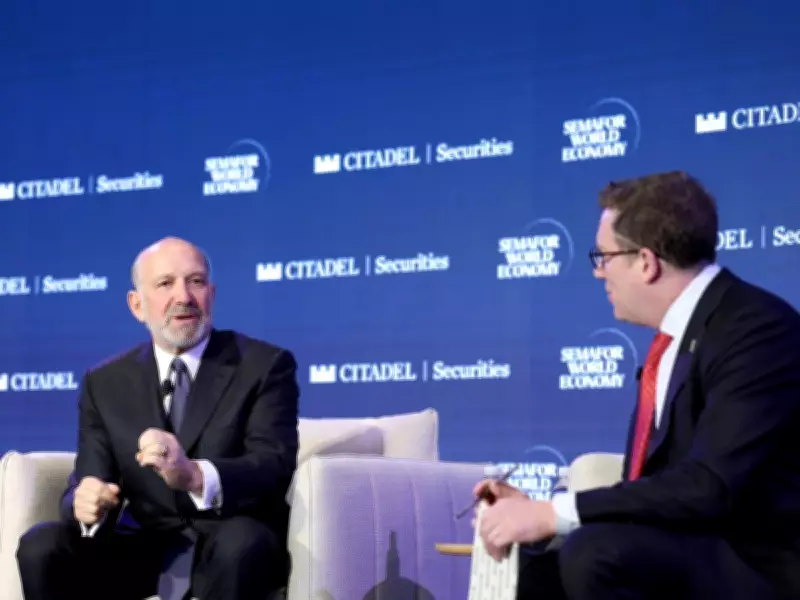
In a blunt and unvarnished critique, U.S. Commerce Secretary Howard Lutnick has unleashed a torrent of criticism against Canada's trade negotiation strategy, labeling it as profoundly ineffective and directly targeting key Canadian officials. The remarks, delivered at the Semafor World Economy summit in Washington, D.C., on April 17, 2026, have ignited a diplomatic firestorm as the Canada-United States-Mexico Agreement (CUSMA) approaches its critical review deadline this summer.
Lutnick's Scathing Assessment of Canadian Strategy
When questioned about Canada's negotiating tactics with the United States, Lutnick did not hold back. "Good for them. That's like the worst strategy I have ever heard. They suck," he declared, dismissing the approach outright. This outburst appears to be a direct response to comments made by Steve Verheul, Canada's chief trade negotiator during the initial Trump administration, who suggested that time favors Canada because pressures on the U.S. are increasing.
Lutnick vehemently disagreed, emphasizing the sheer economic might of the United States. "We are a $30 trillion economy. We are the consumer of the world," he asserted, challenging the notion that Canada holds a strategic advantage. He further criticized what he perceived as flawed logic in Canada's trade decisions, particularly regarding electric vehicles and China.

Targeting Chrystia Freeland and Trade Policies
The commerce secretary's ire extended to former Canadian minister Chrystia Freeland, who played a pivotal role in CUSMA negotiations. When Verheul's comments were mentioned, Lutnick retorted, "Who? Chrystia Freeland, who's like the worst?" This personal jab underscores the deep-seated frustrations in bilateral trade relations, highlighting tensions that have simmered since the agreement's inception.
Lutnick elaborated on his concerns about Canada's trade direction, questioning the rationale behind engaging with China. "Carney has a problem with us. He gets on a plane and he goes to China. Does he think the Chinese economy is going to buy his stuff?" he asked, referring to broader economic strategies. "China is an entirely export-driven economy. So what did he do? He came back and said, 'we'll take their electric cars.' Is this nuts?" This critique points to perceived missteps in Canada's global trade alignments.
White House Response and Diplomatic Fallout
In the aftermath of Lutnick's comments, White House officials moved quickly to mitigate the damage, telling the New York Times that the commerce secretary was "being misquoted." However, the remarks have already reverberated across diplomatic channels, casting a shadow over the upcoming CUSMA review talks scheduled to begin by July 1. The agreement, a cornerstone of North American trade, is set for renegotiation, and Lutnick's outburst could complicate an already delicate process.
The incident highlights the volatile nature of U.S.-Canada trade relations, particularly under administrations with divergent economic philosophies. Lutnick's language, marked by its directness and lack of diplomatic polish, reflects a broader trend of confrontational rhetoric in international trade discussions.
Context and Implications for CUSMA Review
As the deadline for CUSMA talks approaches, Lutnick's comments serve as a stark reminder of the challenges ahead. The agreement, which governs trillions of dollars in trade between the three nations, requires consensus on updates and modifications. Lutnick's criticism suggests that the U.S. may take a hardline stance, potentially demanding significant concessions from Canada.
This episode also raises questions about the role of personal dynamics in trade negotiations. By singling out individuals like Freeland and Verheul, Lutnick has personalized the dispute, which could influence the tone and substance of future discussions. Observers note that such rhetoric may galvanize domestic support in the U.S. but risks alienating key partners.

In summary, Howard Lutnick's candid assessment of Canada's trade strategy has injected a new level of tension into U.S.-Canada relations. With CUSMA review talks on the horizon, his words underscore the high stakes and complex interplay of economics, diplomacy, and personality in shaping North American trade policy. The coming months will reveal whether this confrontation escalates or subsides as both nations navigate the intricacies of renegotiation.