

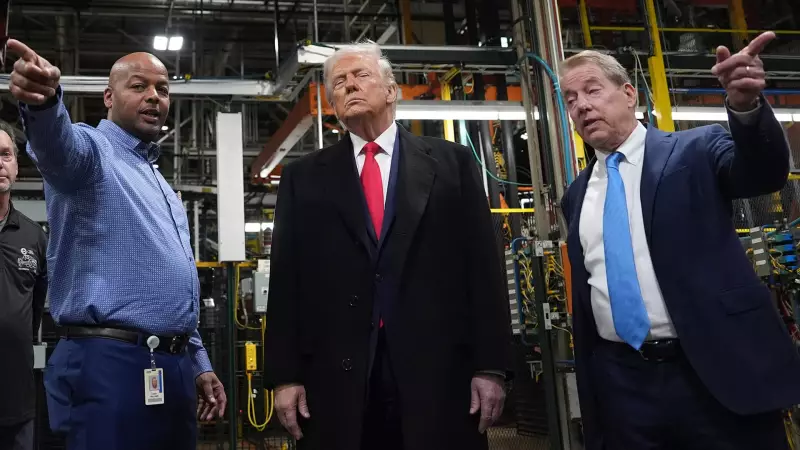
In a stark dismissal of a key Canadian economic sector, former U.S. President Donald Trump has declared that Canada does not need a domestic automobile manufacturing industry and labeled the cornerstone Canada-United States-Mexico Agreement (CUSMA) as "irrelevant." The comments, reported on January 13, 2026, inject new tension into the bilateral trade relationship as Prime Minister Mark Carney embarks on a significant trade mission to China.
A Direct Challenge to Canadian Industry
Trump's remarks represent a direct challenge to the economic foundation of Ontario and other manufacturing hubs across Canada. The automotive sector is a critical pillar of the Canadian economy, supporting hundreds of thousands of direct and indirect jobs. His assertion that "we don't need cars made in Canada" disregards the deeply integrated North American supply chains that have been built over decades under successive trade agreements, starting with the original NAFTA.
The timing of the comments is particularly notable. They emerged as Prime Minister Carney landed in Beijing, aiming to strengthen trade ties and potentially address ongoing disputes, such as the canola tariffs affecting Canadian farmers. This juxtaposition highlights the delicate balancing act Canada faces between its largest trading partner, the United States, and other major global economies.

The 'Irrelevant' Trade Pact and Its Future
Trump's characterization of CUSMA as "irrelevant" raises immediate questions about the trade landscape should he return to power. The agreement, which was renegotiated and signed during his first term, was touted as a modernized replacement for NAFTA. Dismissing it now casts doubt on its long-term stability and signals a potential return to the protectionist and unilateral trade policies that defined his previous administration.
Industry analysts and political observers are now forced to consider the implications. A future U.S. administration hostile to the current trade framework could seek to renegotiate terms again or impose tariffs, creating significant uncertainty for Canadian exporters, especially in the automotive, agriculture, and energy sectors. This uncertainty complicates business planning and investment decisions at a time of global economic fragility.
Broader Context and Canadian Response
The comments arrive amidst a flurry of domestic and international news in Canada. Domestically, issues range from federal job cut notifications and provincial tax increases to severe weather events and local crime investigations. Internationally, Canada is navigating protests in Iran, trade tensions with China, and now, renewed rhetorical challenges from a leading U.S. political figure.
While an official Canadian government response to Trump's specific comments was not immediately detailed in the reports, the underlying message necessitates a strategic evaluation. The federal government's focus on the Beijing trade mission underscores its pursuit of diversified markets. However, the sheer scale of the U.S.-Canada trade relationship means that maintaining a functional and predictable framework with Washington remains an unavoidable priority, regardless of the political players involved.
As the 2026 political cycle progresses, Trump's latest pronouncement serves as a stark reminder that the economic partnership between Canada and the United States, while resilient, may face renewed tests. The coming months will likely see Canadian officials and industry leaders reinforcing the mutual benefits of integrated manufacturing and a rules-based trade system, even as they explore other avenues for economic growth and stability.






