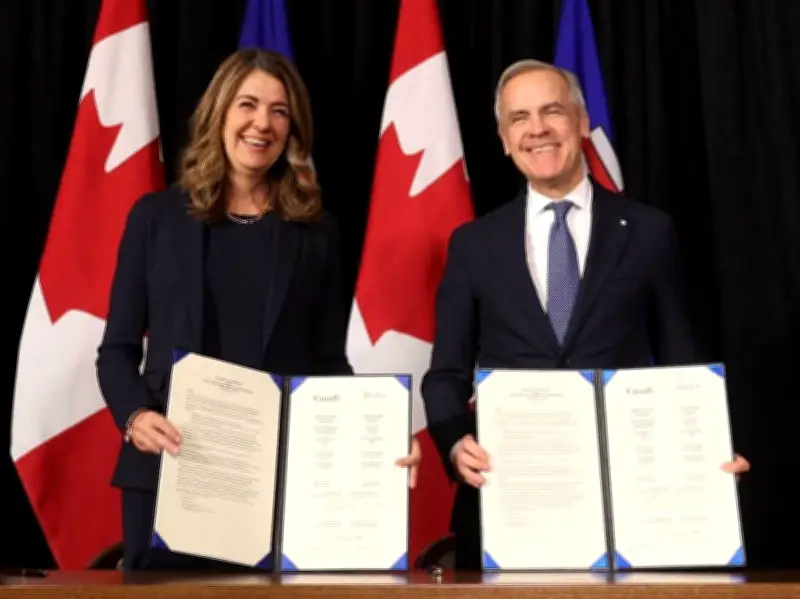
Despite a flurry of agreement signings, handshakes, and photo opportunities between Alberta Premier Danielle Smith and Prime Minister Mark Carney, the path to constructing a new oil pipeline to the West Coast remains fraught with obstacles. While both leaders have expressed a willingness to collaborate, concrete progress has been elusive.
Deadlines Set, But Progress Limited
Last month, Smith and Carney met in Calgary to establish a timeline for the pipeline project. The Alberta government is expected to submit a pipeline proposal to the federal Liberals' major projects office by July 1, a mere three weeks away. In turn, the federal government has committed to designating the pipeline as a "project of national interest" by October 1. Smith has suggested that design and construction could begin "as early as Sept. 1, 2027."
However, aside from an agreement to allow Alberta's industrial carbon tax to rise from effectively $45 per tonne to $130 per tonne, no concrete steps have been taken. Critics question whether this represents genuine progress or merely political posturing.

Carbon Capture Requirement Remains a Stumbling Block
Alberta has yet to meet a key federal precondition: the construction of a carbon-capture system designed to reduce the carbon footprint of the oilsands and related oil extraction and transportation. The major oilsands companies, operating under the Pathways Alliance banner, have agreed to the concept in principle, but the financial burden is staggering. The carbon abatement project could cost as much as $30 billion, on top of the pipeline's projected $30 billion price tag.
Speaking at the Global Energy Show in Calgary, Cenovus CEO Jon McKenzie bluntly stated that requiring the carbon abatement project to proceed hand-in-hand with a new bitumen pipeline makes no economic sense for oil companies. McKenzie described the twin projects as currently conceived as "unfinanceable."
Financing and Opposition Challenges
McKenzie's comments cast doubt on the Pathways project, as Cenovus was expected to be a major contributor. Without carbon capture, federal approval for the pipeline appears unlikely. This raises further questions about whether an investor or consortium of investors can be secured before construction begins, another of Ottawa's requirements.
Additionally, the federal government has demanded agreement from First Nations and the British Columbia government, both of which have expressed hostility toward the pipeline. These preconditions remain unmet, leaving the project's future uncertain.
In summary, while political leaders have made optimistic statements, the West Coast pipeline faces significant hurdles related to cost, financing, and opposition that could ultimately kill the project.