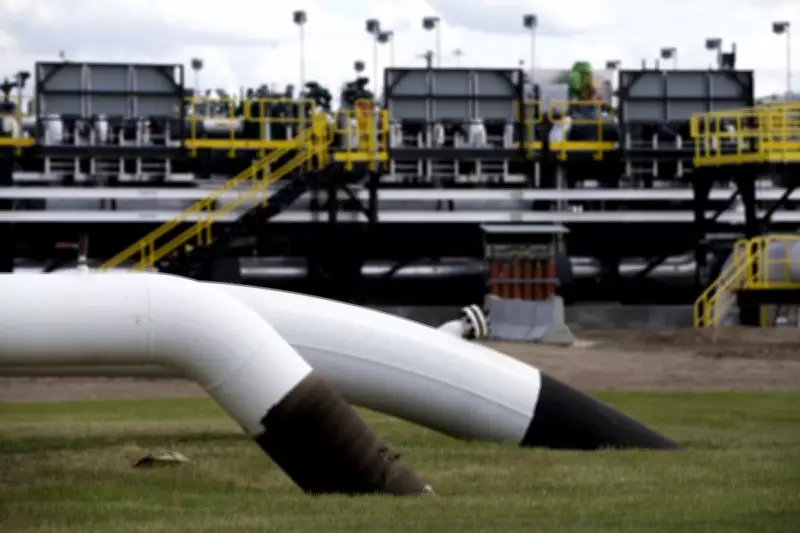
Canada's Energy Export Ambitions Stalled by Infrastructure Deficit
Federal Energy Minister Tim Hodgson recently declared to the House of Commons natural resources committee that Canada possesses the potential to emerge as one of the world's largest suppliers of liquefied natural gas (LNG). This statement, however, starkly contrasts with the reality of the nation's current export capabilities, which remain severely limited due to a decade of Liberal governance under former Prime Minister Justin Trudeau.
Missed Opportunities During the Liberal Era
Minister Hodgson's optimistic projection was made prior to the escalation of tensions between the United States and Iran, which led to the closure of the Strait of Hormuz. This geopolitical event effectively locked in approximately 20 percent of global oil and LNG supplies, sending energy prices soaring and exposing critical vulnerabilities in international markets. While recent events have intensified these pressures, they merely underscore a long-standing issue: Canada's failure to capitalize on its energy resources during what critics term the "lost Liberal decade."
During this period, the Trudeau administration consistently argued that there was "no business case" for developing extensive oil and LNG export infrastructure. This stance resulted in minimal progress on pipelines and export terminals, leaving Canada lagging behind competitors. In contrast, the United States has aggressively expanded its LNG capacity, constructing twelve terminals in the past decade, with seven already operational and five nearing completion. Canada, by comparison, has only one terminal near Kitimat, British Columbia, with plans for just two additional facilities that would still leave the country with merely one-tenth of American export capacity.

Infrastructure Gaps and Political Hesitations
Following his initial remarks, Minister Hodgson pledged that Canada is prepared to "do its part" to increase oil production and alleviate supply shortages caused by the Strait of Hormuz closure. Yet, he has not detailed specific measures or explained how such increases could be achieved without the necessary infrastructure that should have been built over the past ten years. The Liberals' major projects office has outlined a vision for another West Coast LNG terminal, but it lacks a concrete timeline for construction or completion, raising questions about the government's commitment.
Moreover, there has been a noticeable silence regarding opportunities on the East Coast. Building terminals in provinces like Nova Scotia or New Brunswick would provide access to the vast European gas market, but this would require pipelines transporting Western oil or gas across Quebec. Political analysts suggest that the Liberals' reluctance to pursue such projects stems from fears of jeopardizing their 40-plus parliamentary seats in Quebec, where pipeline opposition is strong. This avoidance casts doubt on the government's genuine enthusiasm for transforming Canada into a major energy exporter.
The Path Forward for Canadian Energy
The disparity between ministerial aspirations and on-ground realities highlights a critical juncture for Canada's energy sector. Without significant investment in infrastructure, including pipelines and export terminals, the nation risks continuing to miss out on economic opportunities in the global energy market. As global demand fluctuates and geopolitical tensions persist, the need for a coherent and actionable energy strategy becomes increasingly urgent. The legacy of the lost decade serves as a cautionary tale, emphasizing that political will must align with practical development to unlock Canada's full export potential.