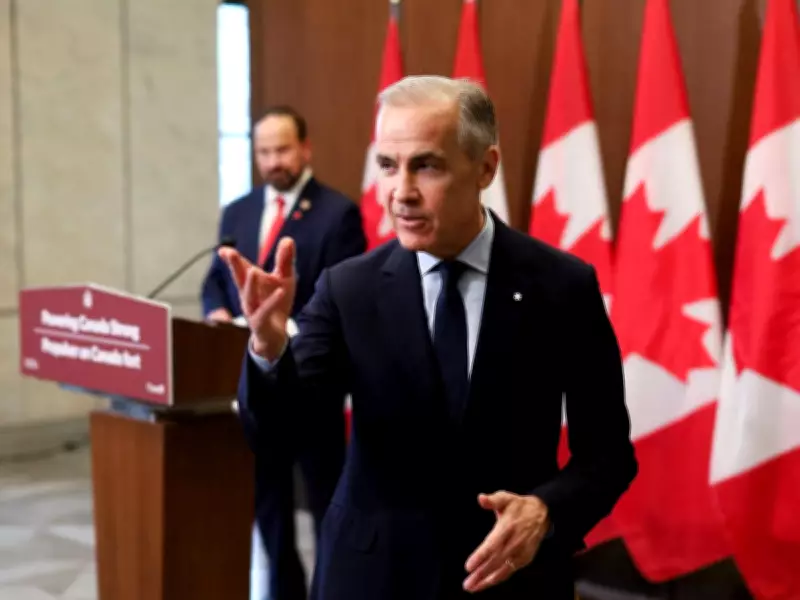
One of the peculiar aspects of Prime Minister Mark Carney's Build Canada Strong pipeline from Alberta through British Columbia to Asia is the list of Make Canada Weaker conditions that must be met before the project is approved.
That's not quite the message Carney delivered Wednesday during his promotional visit to British Columbia. Speaking to the Greater Vancouver Board of Trade, Carney filled the air with his now too-familiar flourishes of clichéd optimism, promising more resilience, more prosperity, more independence, global energy leadership, net-zero carbon emissions, the doubling of non-U.S. exports, Indigenous ownership benefits, relentless focus on affordability, and big gains for provinces.
It was all great optimistic stuff, but only if the audience ignored the actual policies behind all the wondrous economic benefits that Carney said would be delivered by his master plan for Canada's future as a global energy superpower.

The main reason for the prime minister's visit to Vancouver, the Canada Strong project under discussion, was the oil pipeline to the B.C. coast. While nominally approved by Carney and Alberta Premier Danielle Smith in an updated Memorandum of Understanding (MOU) signed last week, the pipeline comes with major high-cost conditions that will do nothing to make Canada stronger while adding financial burdens that will undermine the project — and the economy.
The two major economic risks are the industrial carbon price and the proposed mandate that carbon emissions from oil in the pipeline be buried underground to save the global environment and help Canada achieve net-zero carbon emissions. There are other conditions that have yet to be specified. On Wednesday, Carney included commitments to allocate oil pipeline benefits such as "co-ownership" to Indigenous communities and to allow B.C. to "share" in the pipeline's development.
But carbon capture and carbon pricing are the two main artificial costs that will burden the pipeline and the Canadian economy.
Carbon capture challenges
It takes a lot of imagination to get behind the concept of Carbon Capture Utilization and Storage (CCUS), and a lot of money. A 2024 series of reports from McMillan LLP laid out the foundational problems lurking within the idea that carbon can be grabbed and stored, perhaps underground, to prevent it from hitting the atmosphere.
Among the issues: How to capture it and when, how to transport it, economic uncertainty, and the risk of making Canada's fossil fuel production uneconomic. Above all, the McMillan report titled Making Dollars and Sense of Carbon Markets concluded that CCUS makes no sense without massive amounts of government backing: "CCUS, as it stands, is not a revenue-generating stream for the industry yet." Nor are the plans "economically viable," which means they require "enormous upfront capital outlays in the billions of dollars." Projects also require billions in tax credits and price guarantees, with the report noting "there are also enormous potential liabilities in the event of failure of a storage facility which have not been adequately addressed and incentive programs have been slow to materialize."
The carbon capture and carbon pricing conditions attached to the Canada Strong pipeline are artificial costs that will burden not only the pipeline but the entire Canadian economy. These policies risk making Canada weaker rather than stronger, undermining the very goals Carney promises.