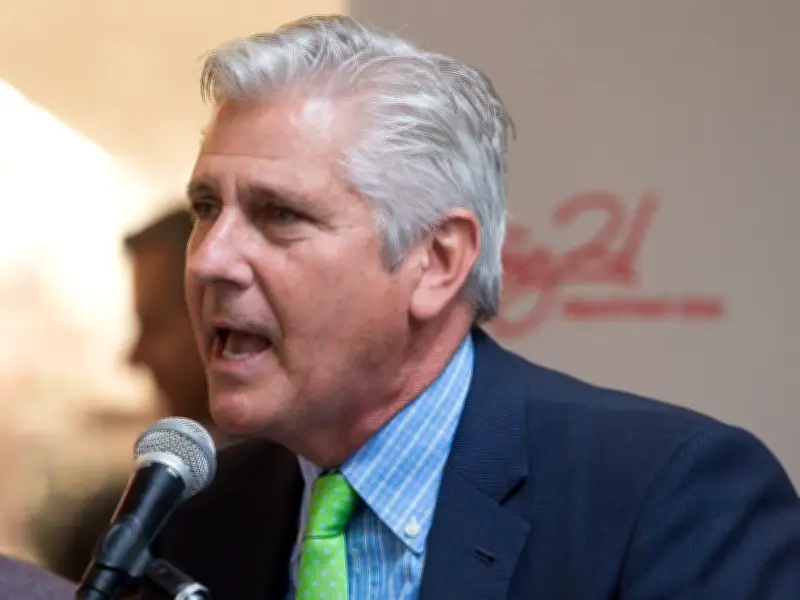
New York State is experiencing an economic death spiral, with companies and taxpayers fleeing to lower-tax states. Gubernatorial candidate Bruce Blakeman has the opportunity to offer real change by proposing a bold plan to phase out the state income tax, which many economists consider an economy killer.
According to a Morning Consult poll from December 2024, 68% of New Yorkers, regardless of party affiliation or age, support eliminating the income tax. Even 40% of Democrats and Democratic-leaning voters strongly support the idea, while only 10% are strongly opposed. This makes the proposal politically viable and economically essential.
While all governments need tax revenue, taxing income is more damaging to the economy than taxing property or sales, as most economists agree. State income taxes drive companies to relocate to lower-tax or zero-tax states, eroding the tax base and causing brain drain. In January, the White House Council of Economic Advisers (CEA) urged states with income taxes to phase them out through a combination of belt-tightening and adopting less damaging forms of tax collection.

The CEA specifically noted that phasing out New York's income tax would do more than save taxpayers money. The average wage earner could see a pre-tax increase of up to $6,757 annually, and business startups could rise by as much as 29%. Many people know someone who has dreamed of starting a business.
Critics will argue that the state income tax provides 30% of funding for state services and local school districts. However, several states are currently phasing out their income taxes using similar legislation, and there is no budget hole. As soon as the state announces the phase-out, business activity picks up. The legislation puts a hard ceiling on future spending, preventing increases beyond current levels. For example, Oklahoma law requires that every time revenue increases by 5%, the state must cut the income tax rate, leaving no discretion for new government programs.
In New York, with its declining population, freezing spending at current levels is reasonable. When the plan is announced and business activity picks up, new revenue will be used to reduce the tax rate. This gradual, fiscally responsible approach can turn New York from a tax hell into a tax haven and economic engine of the Northeast, akin to Florida without the palm trees. The plan will take several years, depending on national economic growth.
Smart states are already moving in this direction. On April 15, South Carolina Governor Henry McMaster signed a plan to phase out the state's progressive income tax, which currently has a top rate of 6%, to zero over time. A South Carolina Policy Council poll last July found that 73% of voters, including 60% of Democrats, favored eliminating the income tax, believing it would attract new businesses.
The CEA suggests that states can eliminate the income tax faster by adopting a broad-based sales tax on goods and services. For New York, this could mean raising the current 4% state sales tax on goods to 8.25% on goods and many services, while exempting groceries and rent to protect the poor. While the math works, these economists are not running for office. Blakeman is unlikely to propose tax hikes, nor should he. Instead, he needs to present a vision of New York as a zero-income tax, high-growth state.
Blakeman is already proposing eliminating the income tax for the first $50,000 earned by single filers and $100,000 by joint filers, along with a 10% tax cut on all income under $250,000. However, these are baby steps that will not attract companies to relocate. Competition among states for corporate business is fierce, with 53% of corporate CEOs open to examining new locations based on taxes, energy costs, regulation, and workforce availability. Companies leaving New York are choosing states with no income tax or a plan to phase it out, leaving Governor Kathy Hochul at a disadvantage.
But New York is not doomed. With a bold plan to eliminate the income tax, Blakeman can improve his chances of winning and turn the state around. Going bold is the key to success.