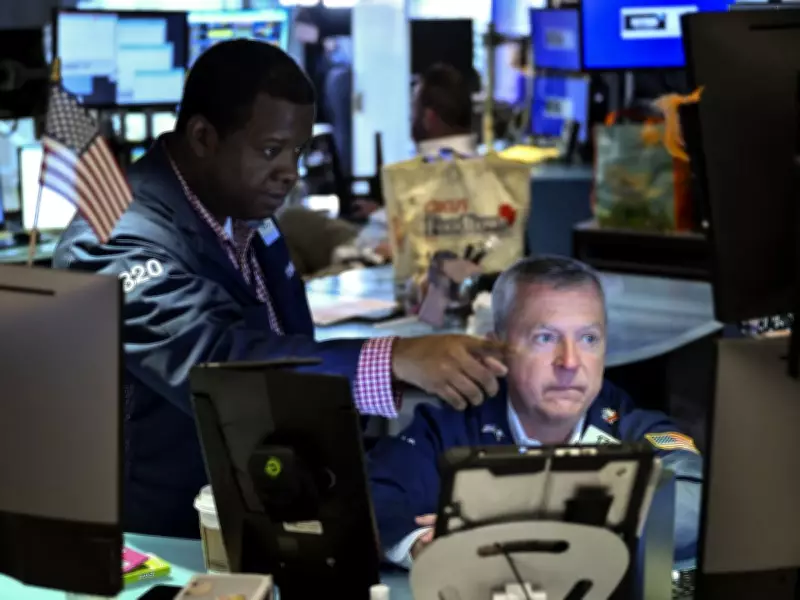
Wall Street Hunts Next Casualty as AI Threatens White-Collar Jobs
Wall Street has awakened to the profound threat artificial intelligence poses to extensive segments of white-collar employment, indiscriminately erasing billions of dollars in market value from stocks across diverse sectors. This sweeping sell-off has impacted wealth managers, insurance brokers, and property services companies, signaling a dramatic shift in investor sentiment toward automation risks.
Tech Launches Trigger Market Turmoil
The recent introduction of advanced AI tools, including Anthropic PBC's Claude Code and Alphabet Inc.'s Project Genie, initially sparked a sell-off in software and video game development companies. However, investor anxiety has rapidly expanded beyond the technology sector itself. Market participants are now deeply concerned about how quickly automation could permeate traditional industries, leading to widespread financial repercussions.
Traders have aggressively responded to developments from relatively unknown startups, triggering successive waves of selling for shares of established players throughout the financial services industry and beyond. Notable companies affected range from The Charles Schwab Corp. to CBRE Group Inc., with even trucking stocks experiencing pressure due to perceived threats to their freight brokerage operations.

Investor Sentiment Turns Indiscriminate
"It feels like a mob with bats looking for the next hit, it's indiscriminate," observed Peter Hébert, co-founder of U.S. tech investor Lux Capital Management and former Lehman Brothers Holdings Inc. equity analyst. This sentiment captures the current market frenzy as investors scramble to identify which industries might face disruption next.
The launch of new tools from insurance AI startup Insurify Inc. and tax planning chatbot developer Altruist Corp. has particularly rattled financial stocks on both sides of the Atlantic. These developments have left market participants questioning which traditional business models might prove vulnerable to AI-driven automation in the coming months.
Warnings from AI Industry Leaders
Traders are increasingly heeding warnings from prominent AI founders, including Dario Amodei of Anthropic, who has suggested the technology could soon function as a "general labour substitute" for white-collar work. This perspective has gained traction as AI capabilities demonstrate remarkable acceleration.
Azeem Azhar, founder of the influential Exponential View AI newsletter, noted that stock market investors are extrapolating from the extraordinary speed at which AI services have improved over the past year. "Today's abilities of agents—bots capable of completing a wide range of tasks with little to no human intervention—would have been incomprehensible a year ago," Azhar explained. This rapid advancement has created what he describes as an "idea contagion" that many computer-based tasks could soon be automated.
Existential Crisis for Professionals
Benedict Evans, an independent technology industry analyst, highlighted there has been a "massive expansion of the number of things" that AI can now accomplish that previously required human professionals to "slog through in Excel." This capability expansion is particularly evident in software development, where Claude Code's proficiency at writing code has plunged many programmers into an existential crisis as AI-assisted "vibe coding" gains popularity.
"The reason so many people in the technology industry are sounding the alarm about AI right now is because this already happened to us," software developer Matt Shumer wrote in a viral blog post. "We're not making predictions. We're telling you what already occurred in our own jobs, and warning you that you're next."
Even Tech Investors Express Alarm
Remarkably, even technology investors who are betting on substantial returns from AI startups have expressed concern about the velocity with which Wall Street has begun selling off legacy companies. This reaction suggests that the financial markets may be anticipating AI's disruptive potential more rapidly than even its most enthusiastic proponents anticipated.

The current market dynamics reflect a fundamental reassessment of how artificial intelligence might reshape traditional employment structures across multiple industries. As AI capabilities continue their exponential growth, Wall Street appears to be positioning itself for what could become one of the most significant economic transformations of the decade.