

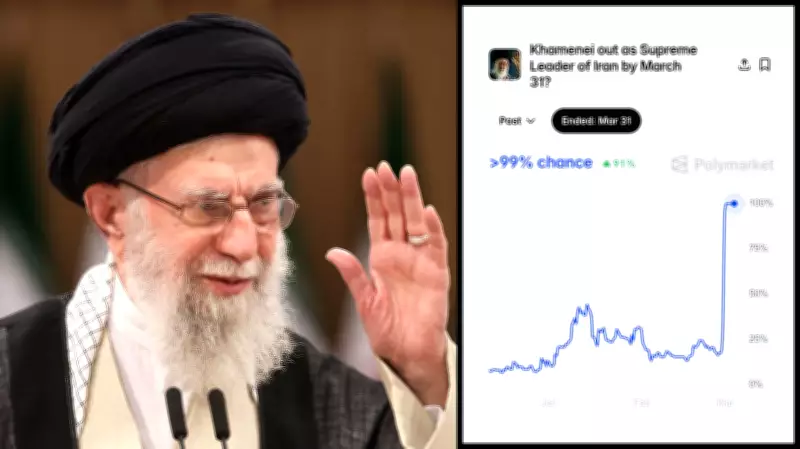
Anonymous Bettor Nets $553,000 on Iran War and Khamenei Ouster via Prediction Market
In the opening days of the Iran war, an Israeli strike killed Iran's Supreme Leader Ayatollah Ali Khamenei. Before this event, a trader using the account "Magamyman" made more than $553,000 by placing bets on the Iran war and the end of Khamenei's rule on Polymarket, which calls itself the world's largest prediction market.
How Prediction Markets Operate and the Ethical Dilemmas
Prediction markets allow users to bet on "event contracts"—wagers on whether specific events will occur, such as Oscar wins, the return of Jesus Christ, or, in this case, the removal of a world leader by a certain date. Khamenei's death quickly resolved the latter bet. While sports betting is commonplace, anonymous individuals profiting massively from war represents a new and controversial frontier.
Polymarket currently hosts over 100 bets related to the Iran war. However, it recently declined to profit from nuclear destruction, archiving a bet titled "Nuclear weapon detonation by ...?" without explanation. The company did not respond to requests for comment from HuffPost.

Federal commodity trading laws prohibit trades based on assassination and war, but Polymarket largely operates on an unregulated overseas exchange. It does not collect customer information and only requires a cryptocurrency wallet for use. Consequently, the identities of bettors like "Magamyman" remain secret, yet they are not alone in cashing in on regime change. People have traded half a billion dollars on Polymarket betting on U.S.-Iran military strikes.
This lack of customer data makes it "more difficult to meaningfully identify insider traders or market manipulation," according to Alex Goldenberg, a fellow at Rutgers University Miller Center on Community Protection and Resilience, in an interview with HuffPost.
Insider Trading and Regulatory Responses
Some Iran war bettors have already been indicted for insider trading using classified military information. In contrast, Kalshi, Polymarket's U.S.-based rival subject to federal regulation, has shown less interest in geopolitical contracts involving a leader's death. Kalshi stated it would not pay out millions in expected winnings from Khamenei being "out as Supreme Leader."
"We don't list markets directly tied to death," Kalshi's CEO said on X. "Oil futures can be proxy markets for war and death. But we believe that's different than having a market directly settling on someone's death, which is not allowed for US regulated entities." The company refunded bettors at the last traded price before Khamenei's death, leading to ongoing lawsuits from bettors.
The Psychological Impact of War Betting
Even if direct bets on leaders' deaths are avoided, wagers related to the Iran war still profit from death, altering how people perceive wealth-building and global events. When military strikes and regime change become wins and losses on a spreadsheet, collateral suffering can become something to root for.
"When a missile strike becomes a 'yes' resolution and a payout, you're almost conditioning people to feel excitement at events that should produce serious conversations," Goldenberg explained. "You do that enough times, I think you've kind of fundamentally changed the way people are interfacing with reality."
Polymarket defended its Middle East markets in a note, saying they "create accurate, unbiased forecasts for the most important events to society" and that this ability is "particularly invaluable in gut-wrenching times like today."
Risky Behaviors and Harassment Incidents
Consuming war through binary forecasts of possible regime change can have long-term effects on how individuals view geopolitical events. Risky bets may spur harmful impulses to seek harm against others to secure desired outcomes.
"If you see the world as an increasingly transactional place... that often leads to not very empathetic or communal behavior," said Hanna Horvath, a certified financial planner and money psychology expert. Rapid financial fluctuations, such as winning or losing hundreds of thousands in hours, "really does change your relationship with risk. And I think it makes people engage in more risky behaviors," Horvath added.

Recently, Israeli journalist Emanuel Fabian reported receiving death threats and harassment from Polymarket bettors pressuring him to alter his reporting on an intercepted Iranian missile strike. According to bet rules, intercepted strikes did not qualify for a "Yes" resolution on a March 10 wager with over $14 million at stake. One individual, identifying as Haim, threatened Fabian over WhatsApp, saying, "After you make us lose $900,000 we will invest no less than that to finish you."
In response, Polymarket stated it had "banned the accounts for all involved & will pass their info to the relevant authorities." The company did not address whether similar incidents had occurred previously or what preventive measures were in place.
Growing Concerns and Regulatory Scrutiny
Experts believe incentivized harassment is not an isolated case. "This problem will grow. We've seen analogous cases in sports betting, where financial incentives have driven harassment and corruption of the people whose judgments and actions resolve contracts — including athletes themselves," Goldenberg noted. "The same dynamic is now playing out with journalists covering active conflicts."
When money is at stake, bettors may lash out. A 2025 survey found that one-third of college basketball student-athletes experienced social media abuse related to sports betting in the past year. Political events are not neutral trades; even terms like "forces enter," "ouster," or "regime fall" can imply threats to lives.
"Markets that resolve on whether someone stays in power, speaks publicly, shows up somewhere, or holds a certain job carry implicit incentives connected to their continued existence," according to an article on assassination semantics by BetBreakingNews, a site covering prediction markets. Sean Guillory, a cognitive neuroscientist and co-author, explained that if a payout depends on someone staying alive or not, it inherently becomes an "assassination market."
Regulatory Efforts and Future Outlook
Congress is examining death markets following Iran war bets. California Democrats Rep. Mike Levin and Sen. Adam Schiff introduced a bill to ban any "contract that involves, relates to, or references terrorism, assassination, war, or an individual's death."
Federal regulation of prediction markets slowed under President Donald Trump's administration, which ended two investigations into Polymarket initiated by former President Joe Biden's administration. Donald Trump Jr. serves as an adviser to both Kalshi and Polymarket. Polymarket initially faced restrictions in the U.S. under a 2022 settlement with the Commodity Futures Trading Commission (CFTC) but received regulatory approval in late 2025 and is launching a CFTC-regulated app for U.S. users.
In March, the CFTC issued guidance stating it may block contracts tied to assassination, war, or terrorism if deemed "contrary to the public interest," but did not impose an outright ban. "Until the CFTC provides clarity as to whether or not the war markets as they stand, mostly on Polymarket, are 'contrary to the public interest,' we're going to see these markets continue to grow exponentially," Goldenberg predicted.
The Temptation of Quick Profits and Insider Advantages
Seeing others profit from such bets can be enticing. Polymarket allows users to view traders' wallets and see profits from specific bets. The platform recently featured "Betwick," a European tech worker who claims to have amassed $800,000 in profits, inspired by leaderboards showing top bettors' earnings.
However, war betting carries financial risks; "Betwick" lost 70% of his money on an "Israel strikes Iran" bet due to being "tilted," a poker term for emotional clouding of judgment. In times of economic uncertainty, people may seek quick profits from missile strikes over long-term investing strategies.
"The ways that most people build wealth is not very sexy. It's slow. It's over decades. But a lot of people, especially younger people, they go online, they see their peers...online claiming, or maybe actually making all of this money in 24 hours, and think 'Well, I want to do that,'" Horvath said. Even with awareness of sensationalism, "your brain will internalize it and start to see it as something that could be somewhat normal."
Horvath cautioned that odds are not in favor of average bettors. While prediction markets claim egalitarianism, "I will really argue, ultimately, the people that will benefit from these types of platforms are the ones that have that insider knowledge," she concluded.





