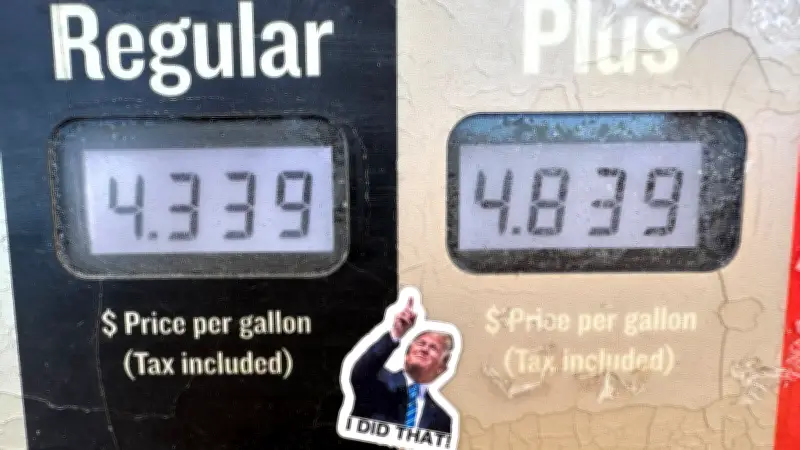
Rising gas prices pushed U.S. inflation to its highest level in three years last month, creating a headache for the Federal Reserve and a potential political challenge for the Trump administration as midterm elections approach.
Consumer Price Index Rises Sharply
Consumer prices increased 4.2% in May from a year earlier, the Labor Department reported Wednesday, up from 3.8% in April. This marks the third consecutive monthly increase. On a monthly basis, prices rose 0.5% in May, following larger gains of 0.6% in April and 0.9% in March.
Prices have now outpaced wage growth for several months, squeezing household finances and souring consumer sentiment. Families are drawing down savings to maintain spending, and more individuals are falling behind on credit card payments. Major retailers have noticed shifts in customer behavior, such as purchasing smaller amounts of gasoline.

Fed's Dilemma
Inflation is now well above the Federal Reserve's 2% target, a threshold it has exceeded for over five years. New Fed Chair Kevin Warsh will preside over his first policy meeting next week, where the central bank is expected to hold its key interest rate steady. However, the Fed is likely to revise its post-meeting statement to remove language suggesting a potential rate cut. With inflation proving stubborn, financial markets anticipate a rate hike by year-end.
Higher Fed rates can increase borrowing costs for mortgages, auto loans, and business loans over time.
Core Inflation Moderates
Excluding volatile food and energy categories, core prices rose at a more modest pace. On a monthly basis, core inflation climbed just 0.2%, down from 0.4% in April. Year-over-year, core prices increased 2.9%, up from 2.8% in April.
Many goods and services continued to see price increases in May:
- Clothing: Up 0.3% in May and 4.8% higher than a year ago.
- Airline fares: Jumped 2.7% in May and are nearly 27% higher than a year ago, driven by pricier jet fuel.
- Electricity: Rose 0.6% in May and are up 5.9% over the past year.
- Grocery prices: Increased just 0.1% from April but remain 2.7% higher than a year ago.
Economists Weigh In
"I don't think we're anywhere near out of the woods yet," said Omair Sharif, chief economist at Inflation Insights. Price increases "were stronger under the hood." Sharif and other economists note that costs for services like child care, home health care, and dental services continue to rise much faster than consistent with the Fed's 2% target.
Bill Adams, chief U.S. economist at Fifth Third Commercial Bank, attributed some of the gains to a crackdown on immigration, which has likely forced employers in those industries to raise wages.
Geopolitical Factors
Inflation had been cooling before President Donald Trump imposed sweeping tariffs in April 2025, which raised costs on many goods. Prices surged after the Iran war made oil and gas more expensive, making affordability a key political issue. Gas prices rose in May due to Iran's closure of the Strait of Hormuz, which cut off about a fifth of the world's oil supply.
Average gas prices rose from about $4.04 per gallon in mid-April to $4.49 in mid-May, according to the Energy Information Administration. They have since fallen back to $4.16 nationally, according to AAA, which could lead to a cooler inflation reading in June. However, gas has remained above $4 per gallon since March.
Broader Economic Impact
More expensive diesel fuel has lifted shipping costs, with companies like UPS and FedEx adding fuel surcharges in recent months. This is likely to push up grocery prices, which jumped 0.7% in April and are 2.9% higher than a year ago.
Stubbornly high inflation has shifted the debate among Fed policymakers. Early this year, many signaled they were inclined to cut the key rate twice more. Now, more officials expect the next move will be a hike rather than a cut.
Despite higher inflation, the job market is improving, with hiring increasing to a healthy level in May, and the economy continues to grow. These positive signs suggest the Fed does not need to cut rates to stimulate growth and hiring, but some officials want rates to cool growth to bring down inflation.

Higher inflation has put Fed Chair Warsh in a difficult position. He advocated for rate cuts last year and was chosen by Trump to replace Jerome Powell after Trump criticized Powell for not reducing rates more quickly. For now, Trump and White House officials are mainly arguing that interest rates do not need to increase, rather than demanding further cuts.