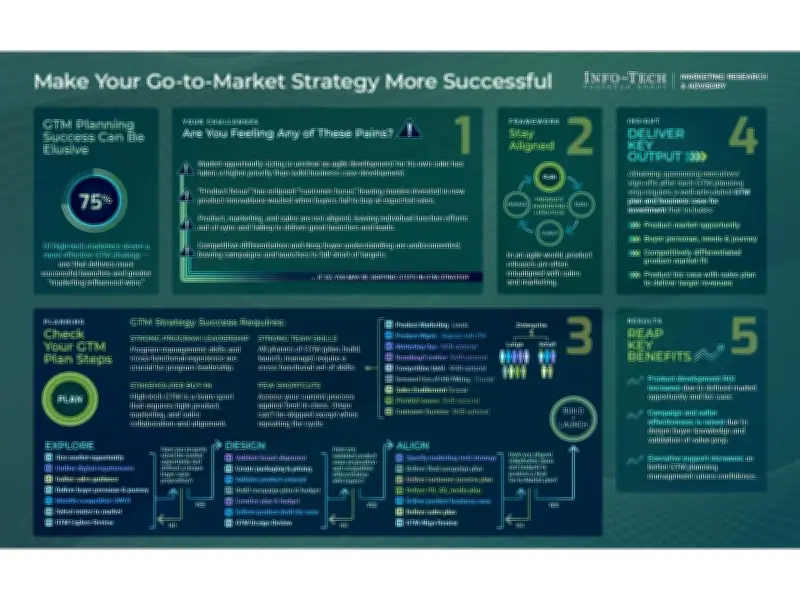
As launch cycles accelerate, many organizations are moving ahead without the buyer insight, competitive differentiation, and internal readiness needed to turn product investment into revenue. Info-Tech Research Group’s newly published blueprint, Build a More Effective Go-to-Market Strategy, outlines a three-phase methodology to help marketing, product, sales, and customer success leaders align around market truth, validate value propositions, and build launch plans that improve commercial outcomes.
Product Launches at Risk Without Buyer Insight
Organizations are under increasing pressure to launch products faster, enter new markets, and demonstrate measurable revenue impact. However, many continue to build go-to-market (GTM) strategies around internal assumptions rather than validated buyer needs, competitive insight, and launch readiness. According to Info-Tech Research Group, weak GTM discipline can contribute to unclear product opportunities, missed launch revenue targets, slowing buyer adoption, and reduced executive support for future product investment.
A Structured Methodology for Success
To help organizations address these challenges, the global research and advisory firm has published its blueprint, Build a More Effective Go-to-Market Strategy. The resource provides a structured methodology for marketing, product, sales, customer success, and revenue operations leaders to align stakeholders, validate market opportunity, define differentiated offers, and build launch plans that connect execution to revenue targets.

Info-Tech’s research emphasizes that an effective GTM strategy is not just a marketing exercise. It is a cross-functional business capability that aligns teams around a shared understanding of who the buyer is, what problems matter most, how the solution delivers value, and what must be in place before launch. Without that alignment, teams risk investing in products, campaigns, and sales motions that do not reflect buyer priorities or market realities.
“A go-to-market strategy cannot be treated as the final layer of messaging before launch,” says Emily Wright, senior research analyst at Info-Tech Research Group. “The strongest GTM strategies are built early, with real buyer insight, competitive understanding, and cross-functional accountability. When teams align around market truth before they build and launch, they improve their ability to focus resources on the opportunities most likely to generate revenue.”
Key Challenges That Undermine Go-to-Market Success
Info-Tech’s blueprint identifies several common obstacles that prevent organizations from realizing the full value of product launches and growth initiatives. These challenges include:

- Unclear product market opportunity, leading to weak business cases and poor investment decisions.
- Poorly defined and prioritized buyer personas, making it difficult for teams to understand buyer needs, pain points, and decision criteria.
- Incomplete competitive analysis that fails to identify the areas where the offering is truly differentiated.
- Assumptions about the buyer journey, including how buyers prefer to research, evaluate, and engage with vendors.
- Business cases built around feature delivery rather than customer value, commercial viability, and revenue goals.
- Limited readiness across marketing, sales, and customer success, resulting in inconsistent messaging, weak enablement, and missed launch execution milestones.