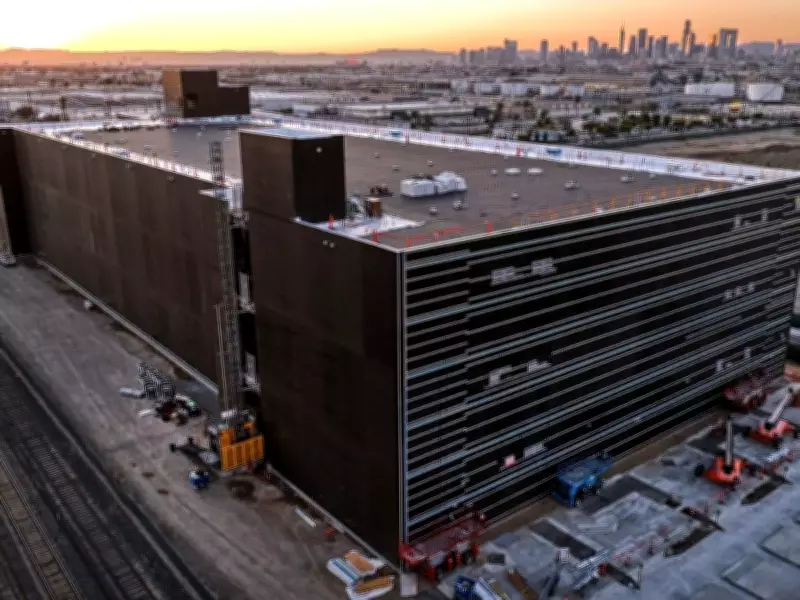
Data centres are massive buildings filled with machines that process the activities we perform on our phones and computers. As artificial intelligence demands even greater computing power, companies are racing to construct more of these facilities.
The Backlash Against Data Centres
Critics are raising alarms. Representative Alexandria Ocasio-Cortez declares, "We must stop it!" Senator Bernie Sanders demands, "Slow it down!" These facilities consume substantial electricity and water for cooling, with a single centre using as much as a small town. "Uses resources like a madman!" protests one activist featured in a recent video.
Last year, protesters blocked or stalled at least 48 data centre projects. In one extreme case, 13 bullets were fired at an Indiana politician's home because of his support for data centres. Now, Ocasio-Cortez and Sanders have introduced a bill to pause new construction.

The Case for Moving Forward
Paige Lambermont of the Competitive Enterprise Institute argues such a pause is misguided. "If our economy developed at the speed of Bernie Sanders, we would be significantly worse off," she says. "If we slow down, other countries won't. You'll end up with the authoritarian Chinese version of AI instead of the innovative U.S. version."
Concerns about rising electricity prices are overblown, according to Lambermont. "So far, it's raised prices nowhere," she notes. "Prices in Virginia are rising more slowly than in some other places, even though Northern Virginia has more data centres than anywhere else." The Institute for Energy Research found "no statistically significant relationship between data centre concentration and faster increases in electricity rates."
The Real Problem: Government Regulation
As AI demand grows, price increases may occur, but largely due to short-sighted policies limiting efficient fuels like natural gas and nuclear power in favor of wind and solar. "If we hadn't done that," Lambermont explains, "we would have between 100 and 200 gigawatts of slack capacity in the power grid already."
Government rules that restrict power production to government-approved monopolies exacerbate the issue. These monopolies are notoriously slow. Microsoft, for instance, struck a deal with Constellation Energy to reopen the Three Mile Island nuclear reactor. The renovated plant could produce power next year, but government regulations prevent Microsoft from using that power until utilities build powerlines across hundreds of miles.
Private Solutions and Innovation
Elon Musk bypassed these burdensome rules by building his own off-grid gas turbines to power his supercomputer in Tennessee. "If you're Elon Musk, you can build your own," Lambermont says, "but most people can't afford to build a gas or nuclear plant." Even those who could face uncertainty: "No one wants to invest billions in something the next presidential administration could declare illegal."
Some in Congress are now pushing to ease off-grid power construction. "You can do new and interesting things if you're running your own operation and making your own rules," Lambermont adds. "That's how every major technological advance has come about—not from government, but from private actors figuring out what works. Data centres are resource-intensive, but so are most productive endeavors in history."
Ultimately, progress flourishes when government steps aside.