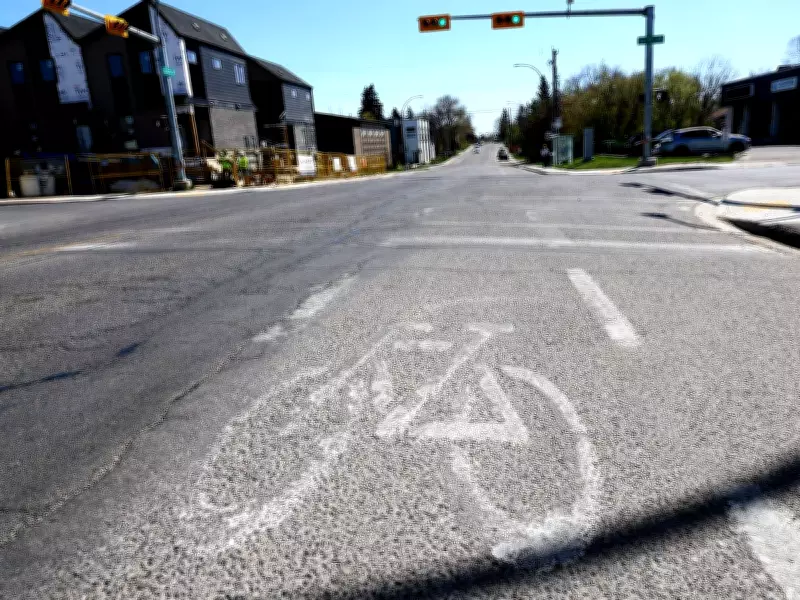
A long-time Calgary cyclist has penned a provocative opinion piece, labeling most separated bike lanes as "a scourge" on the city's streets. The author, Anthony Imbrogno, writes that while he has cycled in Calgary since childhood, the current implementation of bike lanes creates more problems than solutions.
Problems with Separated Bike Lanes
Imbrogno notes that except for a few routes like 12th Avenue S.W. and 5th Street S.W., separated bike lanes look cumbersome, leave green paint chips at intersections, and are expensive to clear of snow. He observes cyclists and scooter riders going the wrong direction or avoiding the lanes altogether, risking safety. Concrete separations on smaller streets are particularly dangerous, as there is no escape route in case of an obstacle.
Alternative Approach Suggested
The author argues that a workable cycling network could have been established cheaply by expanding the existing pathways system, creating separated lanes only where reasonable, and using share-the-road signs elsewhere. He criticizes activists and city administrators for building lanes on every road to inflate statistics about the cycling network's growth.

Provincial Oversight
Pushback against unnecessary lanes is gaining traction. Seniors on 15th Avenue S.W. complained about a bike lane restricting ambulance access. The Alberta government has asked for lane usage data and announced a new law to oversee bike lanes. Imbrogno supports this provincial intervention, stating that roads should primarily move goods and people efficiently.
Exceptions and Recommendations
He acknowledges that separated lanes make sense in some areas, such as along 12th Avenue S.W., which serves a densely populated area and connects to key destinations. However, he insists that city administration must prove the case for existing and planned lanes, rather than pursuing a fantasy of replicating Amsterdam or Copenhagen.
Imbrogno, who has lived car-free in Dublin, Brussels, Montreal, and Ottawa, pleads for restoring sanity to municipal transportation. He points to a residential street bike lane whose concrete abutments could be removed to restore efficient movement and add parking for local businesses. "The fewer obstacles on our roads, the better it is for both safety and movement," he concludes.