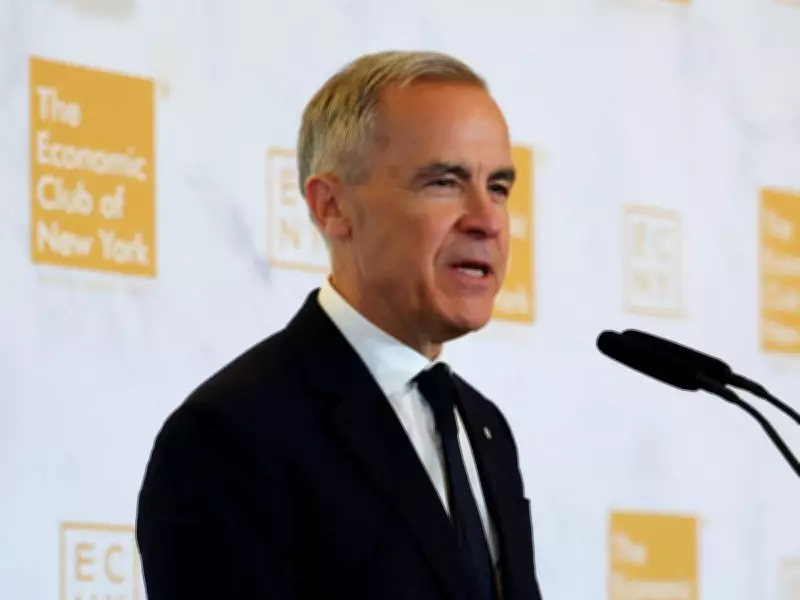
Canadian Prime Minister Mark Carney used a speech in New York to advocate for closer cooperation with the Trump administration on aluminum, auto manufacturing, and critical minerals. Addressing the Economic Club of New York, Carney urged the United States to forge a deeper partnership with what he described as 'a different Canada, a stronger Canada, a more confident Canada.'
Fortress North America Message
Carney's trip comes as pressure mounts on his government to demonstrate ongoing engagement with the US on trade issues. While American and Mexican negotiators have begun formal talks on potential changes to the Canada-U.S.-Mexico Agreement, Canada has not yet been included in those discussions, with no schedule set for bilateral talks. Carney has increasingly promoted a 'Fortress North America' approach, emphasizing that Canada is open to deeper integration with the US.
'Let's be absolutely clear, Canada Strong will help make America great again,' Carney told the audience, blending slogans from both leaders. 'Examples of where that's true are legion, where we should work together and compete with the world together. To those ends, we have made specific practical proposals to the US administration.'

Aluminum and Energy Cooperation
Carney highlighted aluminum as a key area for collaboration, noting that Quebec produces vast amounts of aluminum using cheap hydroelectricity. He stated that Canadian aluminum exports to the US 'are the energy equivalent of 10 Hoover Dams.' He questioned whether it makes sense for the US to build the gigawatts needed to replace Canadian production given America's growing energy demands.
Auto Sector Integration
On autos, Carney pointed out that Canada is the largest customer of American-built cars, arguing that an integrated North American market remains the best strategy to compete with other global automotive sectors. The auto industry is expected to be a contentious issue in trade talks, as the US has imposed 25% tariffs on Canadian-built cars, with exemptions for the percentage of US-made parts. Carney has responded with counter-tariffs on US cars and a remission scheme for companies that build vehicles in Canada.
More controversially, Carney has reduced tariffs on a limited number of Chinese-made electric vehicles, a departure from Canada's previous policy of matching the US's 100% tariff on Chinese EVs. He defended the move, stating that the tariff break is initially capped at 49,000 vehicles annually—a small fraction of the 1.8 million cars sold in Canada each year. He assured the New York audience that over time, a broader range of cheaper Chinese cars would enter the market 'but in a controlled way.'
Broader Context
Much of Carney's speech focused on his government's efforts to expand Canada's energy exports and rapidly enhance military capabilities. The address marked a shift from earlier, more confrontational rhetoric when he described Canada's close integration with US supply chains as a weakness. Now, Carney is emphasizing the mutual benefits of cooperation, particularly in sectors where Canada offers strategic advantages.