Aduro Reports NGP Pilot Plant Campaign Results
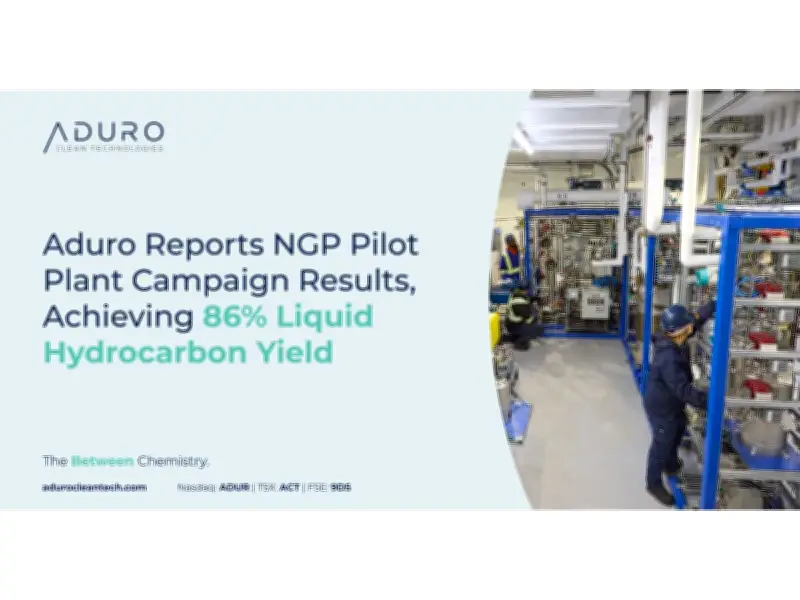
Aduro Clean Technologies Inc. (Nasdaq: ADUR) (TSX: ACT) (FSE: 9D5), a clean technology company focused on transforming lower value feedstocks such as waste plastics, heavy bitumen, and renewable oils into valuable resources, has announced results from the latest operating campaigns at its Next Generation Process (NGP) Pilot Plant in London, Ontario. The campaign demonstrated steady-state operation, process robustness, and consistent product quality, achieving an 86% liquid hydrocarbon yield.
Key Campaign Highlights
The latest campaign was conducted under Aduro's 24/4 operating model, which involves 24-hour operation over a planned four-day window. Steady-state conditions were achieved under typical Hydrochemolytic conditions and sustained throughout the operational window, with samples collected at regular intervals. The process demonstrated robustness, as steady-state conditions were re-established within approximately two hours after intentional operating changes, providing valuable data on process-control response and operator procedures.
Results showed an 86% liquid hydrocarbon recovery over the steady-state window, with 85% of the liquid product consisting of C20-and-below hydrocarbons. This carbon-number range is typically associated with naphtha cracker feedstocks, indicating high-quality output suitable for further refining. Product quality indicators were as expected and comparable to products from batch and R2 experimental campaigns using the same polypropylene recovered from waste plastics.

Feedstock and Future Plans
Polypropylene recovered from waste plastics was used as a controlled feedstock to establish a reliable operating baseline under defined Hydrochemolytic conditions. The results support planning for longer-duration campaigns using mixed polypropylene and polyethylene feedstocks, while also informing design inputs for Aduro's planned first-of-a-kind (FOAK) Industrial Plant.
Over the past few months, Aduro has conducted a structured series of operating campaigns as it transitions from commissioning to sustained pilot plant operations. These campaigns have ranged from single-day tests to four-day operating windows and have progressively evaluated the performance of reactor, feed-handling, and product-recovery systems. Each campaign has produced practical operating data used to refine startup, stabilization, product recovery, and shutdown procedures, as well as to improve equipment performance and integration of the feed-handling, reaction, and product recovery sections into a unified process.
Achieving and holding steady state is a critical measure of process operability. Sustained steady-state operation demonstrates that the feed-handling, reaction, product recovery, and process-control systems can operate together under various operational conditions, paving the way for future commercial-scale applications.