Alan Kessel: Carney's 'covenant' on antisemitism rings hollow
One cannot fully explain the current antisemitism crisis while omitting October 7 and Islamist extremism.
Author of the article: By Alan Kessel, Special to National Post
Published Jun 09, 2026 • Last updated 0 minutes ago • 4 minute read

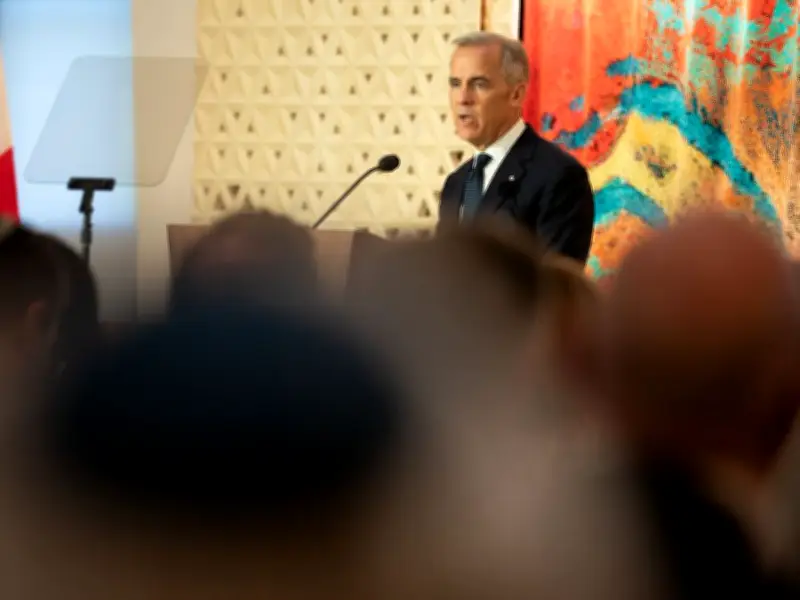
Prime Minister Mark Carney speaks during a visit with members of the Jewish community and law enforcement leaders at Holy Blossom Temple in Toronto, Ontario on Monday, June 1, 2026. (Peter Power/Postmedia News)
Prime Minister Mark Carney chose an ambitious theme for his major address on antisemitism at Toronto’s Holy Blossom Temple: he spoke of covenant. Not policy. Not politics. Covenant.
It was a thoughtful and, in many respects, moving framework. Carney argued that Canada rests upon a covenant among its citizens: a shared commitment to protect one another’s rights, dignity, and place within our national community. He said the explosion of antisemitism across Canada represents a breach. He was right.
But as I listened, I found myself thinking less about what the prime minister said and more about what this moment in Canadian history required him to say. I heard him. I did not feel him.
For Jews, covenant is not merely a political metaphor. It is central to our identity as a people. For more than three millennia, the covenant between the Jewish people and God has defined not only our obligations, but our survival. It is the foundation of Jewish continuity, resilience and responsibility. When Carney invoked covenant, he touched upon something profound. Yet he never fully confronted the forces that have shattered it.
The speech catalogued the manifestations of antisemitism that have become all too familiar: schools shot at, synagogues firebombed, students harassed, businesses targeted, Holocaust memorials desecrated, and Jewish Canadians increasingly fearful of displaying outward signs of their faith. The diagnosis was accurate. The treatment was less convincing.
Most strikingly, Carney never mentioned October 7. He never mentioned Hamas. He never mentioned the Canadians murdered during the largest massacre of Jews since the Holocaust. That omission matters.
October 7 is not a peripheral event in this story. It is the event that transformed antisemitism from a historical concern into an immediate and daily reality for Jewish communities around the world, including in Canada. The wave of hatred that has swept through our campuses, streets, and institutions did not emerge in a vacuum. It emerged in the aftermath of Hamas’ atrocities and the global campaign that followed to justify, rationalize or celebrate them. One cannot fully explain the current antisemitism crisis while omitting its catalyst.
Equally troubling was the absence of any serious discussion of Islamist extremism. Across Europe, governments are increasingly confronting this reality. They have come to recognize that modern antisemitism comes from multiple sources: the far right, the far left, and increasingly from Islamist movements that have successfully imported Middle Eastern hatreds into Western democracies. Canada remains hesitant to have that conversation.
The prime minister’s speech reflected this. He condemned antisemitism without naming many of its principal contemporary drivers. That may be politically prudent. But prudence and leadership are not always the same.