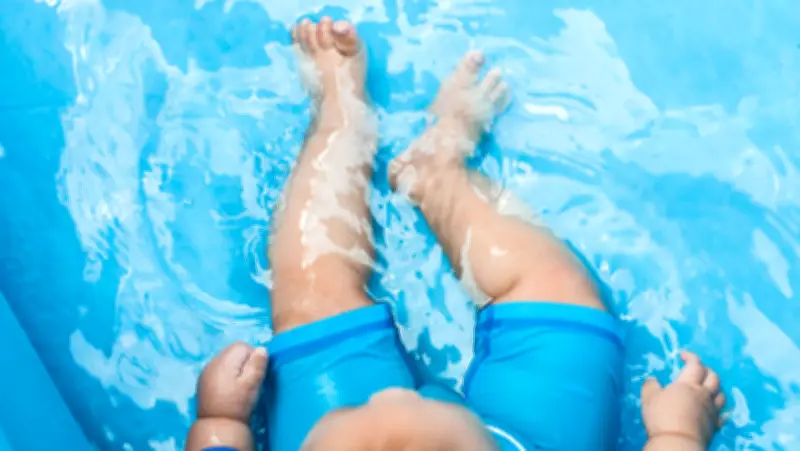
Summer means families are spending more time in and around the water: pool parties, beach days, and boat rides are all more common this time of year. As temperatures heat up, brushing up on water safety is crucial for everyone, but particularly for parents of young kids. According to the CDC, drowning is the second leading cause of death for kids ages 1 to 4. In addition to educating yourself on drowning prevention, there is a little-known factor to consider when taking your kids swimming this summer — the color of their bathing suits.
The Science of Swimsuit Visibility
Alive Solutions, a company specializing in water safety, conducted an informal study in 2020 to test how visible different colored swimsuits would be in light-bottomed pools, dark-bottomed pools, and lakes. For the pools, they tested what the suits looked like underwater and then again with some surface agitation from the perspective of a person standing on the pool deck.
“We do drowning investigations and know that visibility is important in drowning recognition,” Natalie Livingston, co-founder of Alive Solutions, told HuffPost. “As lifeguards and aquatics professionals, we know that there are certain factors that can make someone easier or more challenging to see in the water.”

“Knowing this as our background, we started to look at swimwear for our kids and realized that so many parents were selecting swimwear that was super cute and fashionable, but would cause their children to potentially disappear under the water,” she said.
Best and Worst Colors by Environment
Neon colors that provide contrast performed the best in both pools and lakes. For light-bottomed pools, neon pink and neon orange stood out the most, while white and light blue suits stood out the least. Dark colors like purple and black could be seen well but are not recommended, as they could be mistaken for dirt, leaves, or a shadow.
For lakes and dark-bottomed pools, neon orange, neon green, and neon yellow were the most visible. Notably, neon pink did not perform well in the lake setting. White was visible in that environment but could easily be confused for light reflection on the surface of the water, so it is not recommended.
“The goal was really to show others how to stay more visible and also how water is challenging to look through. It is not like looking through air,” Livingston said. “Overall, neons came out in the lead in all categories.”
It is also worth noting that in the lake setting, at two feet of depth, visibility went down to zero for all the colors tested — a good reminder about the importance of wearing life jackets in open-water environments since they keep swimmers at the surface. (Note: Unlike life vests, water wings, tubes, baby circles, and other inflatables are not considered safety devices.)
Kids ages 5 and under should also wear life jackets in pools if they are not protected by “touch supervision,” which means a caregiver is “within an arm’s reach of the child at all times,” according to the National Drowning Prevention Alliance. The color of your child’s bathing suit is of little importance if other safety measures are not being taken.
Expert Perspectives on Swimsuit Color
Mario Vittone, a former Coast Guard rescue swimmer and drowning expert, said that considering the visibility of swimsuit colors in pools is “not a bad idea” and that avoiding white and blue ones is a good call. But he would not go so far as to say neon-colored suits are “safer.”
“If the color of the suit comes into play, then the drowning has probably already occurred. Being able to easily spot the kid laying on the bottom is good, but it is significantly less good than never letting them get to the bottom in the first place,” Vittone told HuffPost.
“A child in a light blue bathing suit that has had swim lessons and is swimming in a well-guarded pool is an order of magnitude safer than a child in a hot neon yellow suit who has not had swim lessons in a pool guarded by one lifeguard who never takes breaks.” Indeed, getting your child swim lessons at a young age can reduce their risk of drowning. Make sure you have a good understanding of your child’s swimming abilities — and your own skill level, too.

But as the American Academy of Pediatrics noted, “even advanced swimming skills will not always prevent drowning” and “swimming lessons must be considered only within the context of multilayered protection.”
Supervision: The Most Critical Safety Measure
Constant, careful, undistracted adult supervision is absolutely essential when kids are in and around the water. Drowning happens very quickly — sometimes in a matter of seconds — so even looking away to quickly check your phone or grab a snack can be dangerous.
“Watch — with your eyes — the children in the water, the entire time they are in the water,” Vittone said, while also recommending that adults watch any lifeguards present for about 15 minutes to determine how attentive they are being. Having an adult act as the designated “water watcher” is a good idea, too. Just be sure to switch off who is on duty every 15 minutes or so to give each other breaks and to stay sharp.
“When everybody is watching, nobody is watching,” pediatrician and former lifeguard Dr. Sarah Denny recently told HuffPost. “We see this all the time: A whole group of adults is around and a child drowns, and it is not anyone’s fault, but it is just that everyone assumes everyone else is watching.”
Recognizing Drowning
Drowning can be difficult to recognize, so it is important to know what to look for. It does not look like the thrashing, splashing, yelling-for-help depictions that you have seen in movies. As Vittone wrote in a viral post on his website, it is “almost always a deceptively quiet event.”
“Children playing in the water make noise. When they get quiet, you get to them and find out why,” he wrote.
Look for signs like the child’s head tilted back and low in the water with their mouth open at water level. Other signs include gasping for air, hair covering their face, and eyes that are open, glassy and empty or tightly shut. The swimmer may also look like they are trying to climb an invisible ladder.
Additional Precautions
Another important precaution: Add barriers like a four-sided fence with a self-closing and self-latching gate around a pool or hot tub to restrict access.
“If your home represents the fourth side of the pool, make sure you have a door alarm, so you are alerted if your child leaves the home,” Consumer Product Safety Commission spokesperson Nikki Fleming previously told HuffPost. “In addition, you can also use a pool alarm that will signal an alarm if the child were to actually enter the water.”
Learning CPR can be another life-saving tool to add to your arsenal. When dealing with a drowning victim, experts recommend you start by giving rescue breaths. “It is not normal, layperson, compression-only CPR,” Livingston said. “Drowning care first starts with air — time without oxygen is critical in the outcome, so giving breaths first is so important.” You can find trainings in your community or online via the Red Cross and other organizations.
Recommended Neon Swimsuits for Kids
Need help finding a colorful suit? Here are some top picks for high-visibility swimwear:
- Target: A colorblock one-piece with UPF 50+ sun protection in girl's sizes XS-XL ($17).
- Target: A lime green swim set for boys, including a rash guard and trunks with UPF 50+ (rash guard $15, trunks $13).
- Nordstrom: A one-piece rash guard for babies with hibiscus print and UPF 50+ (sizes 0-24 months, $52).
- Target: Lime boy's trunks with shark design, UPF 50+ (XS-XL, $13).
- Amazon: A neon orange rash guard with UPF 50+ (toddler sizes 2-5 and boys' 6-16, $13.09+).
- Old Navy: Bright orange swim trunks for toddlers (12-24 months and 2-5 years, $11).
- The Children's Place: Neon yellow trunks for babies and toddlers (6-24 months and 2-5 years, $8.97).
- Nordstrom: A tangerine off-the-shoulder one-piece with UPF 50+ (girl's sizes 8-14, $52).
- Amazon: A cross-back bikini with pom pom detail (girl's sizes 5-12, $16.99).
- Nordstrom: A puff-sleeve two-piece by Stella Cove in lime green (sizes 8-16, $48).
- Gap: A three-piece girl's swimsuit with UPF 50+ (sizes 4-16, $45).
- Nordstrom: Vans board shorts for tweens (sizes 8-12, $40).
- Amazon: A UV-protective rash guard for girls with UPF 50+ (sizes 6-16, $23.98).
- Nordstrom: An orange flutter suit for toddlers and kids (sizes 1-10, $125).
- Nordstrom: A neon yellow cut-out one-piece (sizes 7-16, $46).