Once upon a time, I was the president of the so-called Build-a-Brother team, where I would attempt to use my Black girl magic to heal the pieces of broken men. For my troubles, I was left with wounds that were slow to heal and lessons I was even slower to learn. Still, I had the privilege of healing privately and later — when I was ready — I shared my scars and not open wounds. As a writer, I pull from these lessons and have shared some ugly truths about how I eventually landed in a beautiful space. After a private heartbreak that only a few close to me witnessed, I loved myself back to life and continued my public career as a speaker and author.
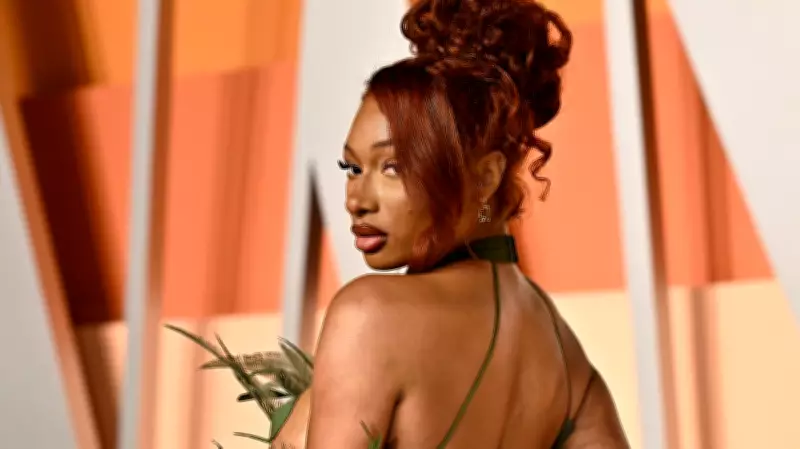
Megan Thee Stallion, a megastar and household name, is going through something similar but healing much more publicly, while contending with higher stakes. In short, she’s modeling what it looks like to be radically human in public. Recently, the Houston rapper shared news of her breakup with Dallas Mavericks guard Klay Thompson, insinuating that it had ended because he cheated. “Holding you down through all your horrible mood swings and treatment towards me during your basketball season, now you don’t know if you can be ‘monogamous,’” Meg wrote in her Instagram story. After catching wind of Thompson’s alleged transgression, it did not take long for us, her supporters, to draw our lines in the sand. Black women, ever so protective of our sis, immediately poured out love for her online. And those messages were swiftly chased by posts from misogynistic men mocking her pain.
Despite the ugliness of the latter, something magical happened. This beautiful, enduring artist put down the weight of the cape in public, rejected the “Strong Black women” trope, and revealed her vulnerability when she concluded her April 25 performance in “Moulin Rouge!” on Broadway. She may not know it, but the tears she shed on stage meant so much to fans like me. Meg is no stranger to online hatred, yet she still chose to subject herself, rejecting a label forced upon generations of Black women. Strong Black women suffer in silence. Strong Black women show healed scars, not open wounds. We might share the story of our suffering when it’s a distant memory, but not when it is a current tender situation. Strong Black women certainly can’t allow themselves to cry in front of the world, and surely, they can’t allow the hurt to ease from their fingers and post about their pain on social media.

Meg choosing to eschew the “Strong Black Woman” trope in favor of modeling a complete display of humanity offers layered benefits to herself and those watching her during this critical moment. From an epidemiology standpoint, the archetype contributes to the widely reported health disparities between Black and white women. The “Superwoman Schema (SWS),” a framework developed by Dr. Cheryl Woods-Giscombé, stipulates that the cultural expectations of Black women to remain strong at all costs and “suppress vulnerability” impact the health of Black women and often contribute to illnesses such as adverse birth outcomes, cardiovascular disease, lupus and obesity.
This research coincides with data around cellular harm caused by social marginalization, which, as Arline T. Geronimus, a professor of health behavior and health equity at the University of Michigan’s School of Public Health, noted, causes “weathering” of the body — or the physical and mental chipping away at our bodies for generations due to systemic racism and the institutionalized dismissal of our health and pain. The combination of social marginalization and adopting the legacy of perpetually suppressing our emotions to appear strong is having dire consequences for Black Americans (and specifically, I argue, women). While Black may not crack on the outside, the fatal duo is causing long-lasting internal structural damage.

Black women like Meg who reject that cultural inheritance of consistently performing strength are, in fact, rescuing themselves. This seemingly subtle but brave act has implications for generations of women. By being open with us about her joy and sadness, Meg chooses to both hurt and love out loud. This is a rare feat of vulnerability that many artists opted not to contend with. I’m reminded of the hip hop canon — a Jay Z song about not being able to grapple with such duality publicly when he was Meg’s age. “I can’t see ’em coming down my eyes / So I gotta make the song cry,” the 31-year-old Jay Z admitted, on “The Blueprint.” Meg let us see them coming down her eyes — and this transparency moved mountains.
Her millions of fans saw her tears, her heartbreak and her heart racing. She invited us to experience her humanity in all its influx of emotions. More importantly, she allowed herself to experience the different elements of her own humanity. In a world that often forces Black women to perform strength during insurmountable pain, sometimes allowing yourself to just be human can feel supernatural — like magic, if you will. Perhaps the real Black girl magic is the ability to reject generational labels, refuse to make a song cry, and instead, be human in public. Which, for a Black woman in America, is a radical act.