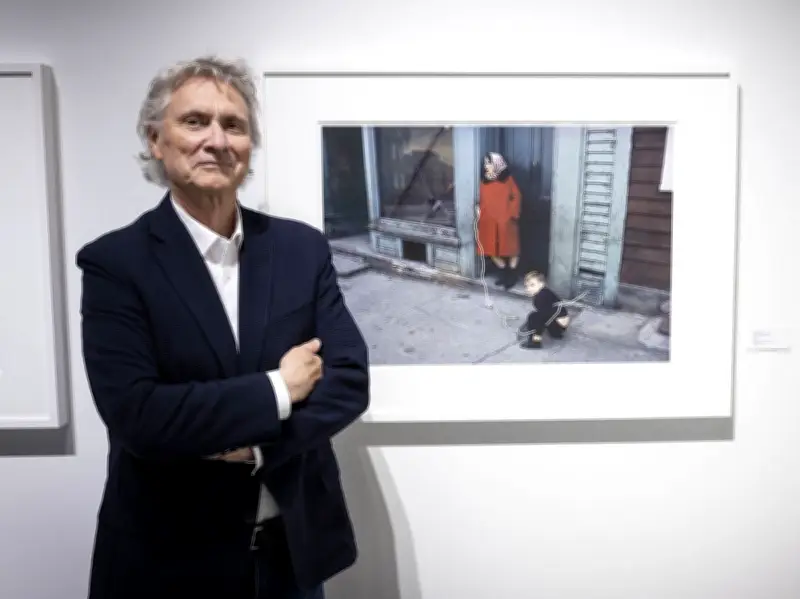
In 1969, Vancouver photographer Fred Herzog took a trip to Halifax. Walking down the street, he came across a woman in a red coat and pink scarf, yawning as she leaned against a somewhat dilapidated wooden building. Beside her is a white rope, tied up to a hook. The rope cascades down to the sidewalk, where it is tied around the waist of a young boy in dark clothes, squatting so you can see the top of his bum.
Herzog caught the moment with his Leica camera, funny and touching and a glorious mix of colours — the deep red of her jacket standing out against a black door and the faded blue-green of the building, which has a cracked window. The image lay hidden among Herzog’s 80,000 slides for decades before his art dealer Andy Sylvester discovered it.
Sylvester had undertaken the daunting task of going through Herzog’s collection after the photographer died in 2019, two weeks shy of his 89th birthday. Towards the end, Herzog had Sylvester over to his house to go through some slides. “He started projecting lots and lots of slides, and I had the feeling that I’ve never seen any of these,” Sylvester said. “Finally, after a few trays I said, ‘Fred, I’ve never seen these.’ And that caused him to question his system of 50 years of organizing slides. He went to the lawyers and said, ‘After I die, here’s what I want to happen. I want one editor to go through everything.’”

Sylvester was a natural for the job. But it took six years to go through all of Herzog’s slides. Finally, 69 of Herzog’s lost images have been unveiled to the world in a new exhibition at the Equinox Gallery called Fred Herzog, A Colour Legacy, which runs through June 27.
Herzog's Artistic Journey
Born in Germany, Herzog moved to Vancouver in the 1950s, where he set out to document the real life of the city, in colour. In the new show, this means a series of arrows in a parking lot, a stylish Pepsi sign in Caracas, Venezuela, or waterfront workers scraping a giant freighter. Herzog could make art of almost anything. But he was a stickler for quality, and didn’t make prints of his colour slides for decades because he didn’t like the way the colour reproduced. He was unknown outside the local art world until his breakthrough exhibition at the Vancouver Art Gallery in 2007.
Now internationally acclaimed, Herzog is known for his photographs of Vancouver. But he travelled to 30 countries, and the new exhibit includes many shots from his travels.
The Selection Process
Sylvester used Herzog’s own Zeiss slide projectors to go through the collection, but it took time. “I would project them, and then do what I called a distillation method, which is the method that he used when we worked together,” he explains. “If there’s one image in the slide tray of 60 that you thought was great, you moved it to a new slide tray, and when that tray filled up with really good pictures, you took the best of that tray and moved into another tray.”
The result is a stunning collection that showcases Herzog's unique eye for colour and composition, offering a fresh perspective on his legacy. The exhibition is a must-see for photography enthusiasts and anyone interested in the vibrant history of Vancouver.