Zacatecas Silver Reports High-Grade Gold and Silver Surface Sampling Over 2 km Strike Length at Oso Negro, Sonora
VANCOUVER, British Columbia — Zacatecas Silver Corp. has announced the assay results from its initial rock-chip sampling program at the Oso Negro project in Sonora, Mexico. The program, completed in March 2026, returned high-grade values of up to 14.8 g/t gold and 2,340 g/t silver, confirming significant mineralization across a 2 km strike length.
Sampling Program Highlights
- Up to 14.8 g/t Au and 2,340 g/t Ag from surface rock-chip sampling.
- 39 of 134 vein samples assayed above 1 g/t Au; 35 samples above 100 g/t Ag.
- Strong correlation between gold, silver, lead, and zinc across the vein system.
- High-grade results confirmed across a minimum 2 km combined strike length on two veins.
- Samples collected above the boiling zone, indicating highest-grade portion remains untested at depth.
- Three outcropping low sulphidation veins identified, up to 3 m wide, multiphase and brecciated.
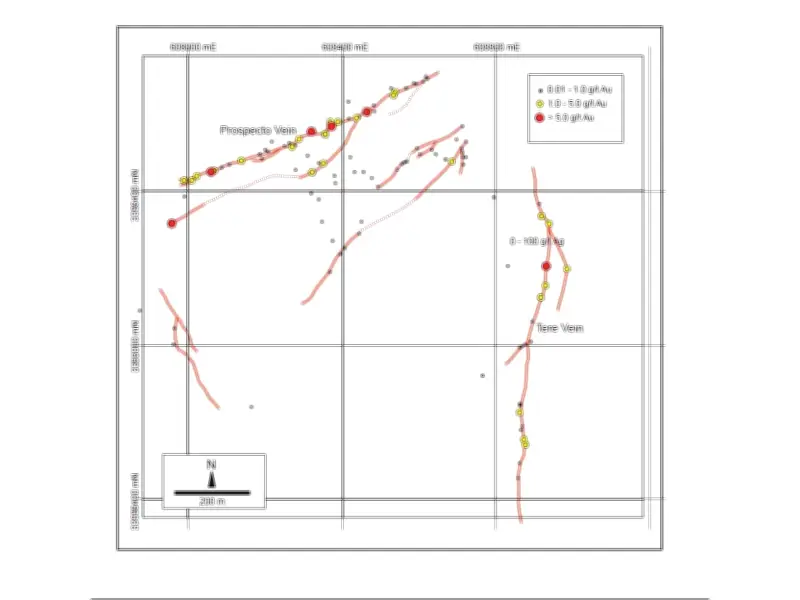
A total of 156 rock-chip grab samples were collected from three outcropping low sulphidation veins with a cumulative strike length of over 2 km. Of these, 134 samples were taken directly from vein outcrop, while 22 were orientation samples from host rocks distal to the veins. The veins are up to 3 m wide, multiphase, with common vein breccias and pervasive iron oxides after sulphides.
Among the 134 vein samples, 39 assayed between 1 g/t Au and 14.8 g/t Au, 35 assayed between 100 g/t Ag and 2,340 g/t Ag, and 11 assayed over 1% combined lead and zinc. Gold, silver, lead, and zinc show strong positive correlation throughout the sample population. High-grade results were returned across the full strike length of the Prospecto Vein and over approximately 1 km of the Tere Vein.

The significance of these results is amplified by three geological factors. First, quartz vein textures and mineralogy confirm that samples were collected from the uppermost levels of the low sulphidation system, above the boiling zone where precious metal deposition is concentrated. Second, many samples were partially oxidized and leached at surface, conditions that typically suppress assay values relative to fresher material at depth. Third, despite these factors, anomalous gold and silver grades were returned consistently across the full 2 km strike length of the system. Taken together, the results indicate that the highest-grade portion of the Oso Negro system remains intact and untested below the current sampling interval.